7 Best Telescopes for Viewing Planets and Galaxies: Reviewed
Disclosure: This post contains affiliate links and I may earn a small commission (at no extra cost to you) if you click through and make a purchase. Thanks in advance – I really appreciate it!
Our comprehensive review of the best telescopes for viewing planets and galaxies will introduce you to some amazing telescopes that will enable you to scope out this stellar scenery and satisfy your cosmos curiosity.
We’ve also included a buying guide after the reviews later in the article. If you want to learn more about telescopes before you buy, or just want to make sure you’re getting good value for your money, be sure to check it out.
We have combed through the details and reviews for dozens of great telescopes to find the best ones so you don’t have to.
Our Top 3 Picks
Top Telescopes for Planets & Galaxies - Reviews
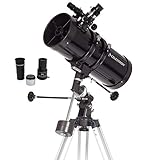
1. Celestron - PowerSeeker 127EQ (Best For Beginners)
- PERFECT ENTRY-LEVEL TELESCOPE: The Celestron PowerSeeker 127EQ is an easy-to-use and powerful telescope. This 127mm Newtonian Reflector offers enough light gathering ability to see planets, the Moon's craters, distant stars, the Orion Nebula, and more.
- MANUAL GERMAN EQUATORIAL MOUNT: With its slow-motion altitude rod, the German Equatorial mount allows you to navigate the sky with ease. Find celestial objects quickly and follow them smoothly & accurately as they appear to drift across the night sky.
- COMPACT AND PORTABLE: The ideal telescope for adults and kids to use together, the PowerSeeker is compact, lightweight, and portable. Take it to your favorite campsite, a dark sky observing site, or simply the backyard.
- MULTIPLE ACCESSORIES: The Celestron PowerSeeker 127EQ Telescope comes with 2 quality eyepieces (20mm and 4mm) plus a 3x Barlow lens to triple the power of each. You'll also receive a FREE download of one of the top-rated astronomy software programs.
- UNBEATABLE WARRANTY & SUPPORT: Buy with confidence from Celestron, a leading telescope brand in California since 1960. Your purchase includes a 2-Year US Warranty and unlimited support from our team of US-based experts.
Specifications
- Type: Reflector
- Aperture: 127 mm(5″)
- Focal length: 1000mm
- Focal Ratio: f/8
- Mount: German Equatorial
- Eyepiece: 20mm, 4mm
- Magnification: 50x, 250x
- Weight: 22.0 lbs.(10.0 kg)
The Celestron PowerSeeker 127EQ telescope is a Newtonian reflector, which means it collects light from the sky through mirrors and reflects it again for viewing.
Two eyepieces (4mm and 20mm) and a 3x Barlow lens are included with the PowerSeeker 127EQ.
The 127mm PowerSeeker model’s 5-inch mirror limits practical magnification to around 250x, which may be attained with the 4mm eyepiece.
A more usable 50x magnification is provided with the bigger 20mm eyepiece. When used with the 3x Barlow lens, the magnification increases to 150x.
The telescope is great for near-deep-sky viewing, making it one of the best telescopes for planets and galaxies for beginners.
Although the telescope will not resolve images of the fainter DSOs, however, it can show you great views of the brighter galaxies and larger planets.
Why We Recommend It
The Celestron PowerSeeker 127EQ 127mm f/8 Reflector Telescope has a big, parabolic mirror that produces clear images of the Moon, vivid views of the planets, and it has the capacity to focus on brilliant distant objects like nebulae and galaxies.
The PowerSeeker 127EQ is extremely portable, and the telescope along with the tripod could easily fit in the trunk of a car.
An Equatorial mount is included with this telescope, which is the best suited for astronomy telescopes.
Two manual slow-motion controls are included, allowing for better object tracking as they travel through the night sky.
This telescope features an erect image diagonal for the right way up images, which prevents some spherical aberration which is common with most reflector telescopes.
Pros
- Solid build quality
- Stable mount
- Comes with a 3x Barlow lens
- Portable
- Easy to set up & use
Cons
- Spherical mirror leads to some spherical aberrations
- Needs occasional collimation
2. Celestron NexStar 4SE Computerized Telescope
- ADVANCED TECH MEETS ICONIC DESIGN: The NexStar 4SE pairs Celestron’s legendary orange tube with a fully computerized GoTo system—ideal for those ready to step up from manual scopes and explore more of the night sky with precision and ease.
- 4-INCH MAKSUTOV-CASSEGRAIN OPTICS: The 4" aperture, combined with high-contrast, long focal length optics, delivers sharp views of the Moon and planets, while remaining compact and easy to transport.
- FULLY AUTOMATED GoTo MOUNT WITH NEXSTAR+ HAND CONTROL: Use the NexStar+ hand control to select from a 40,000+ object database. The computerized mount then automatically slews to your target and tracks it—no star charts or manual alignment needed.
- FAST & EASY ALIGNMENT WITH SKYALIGN TECHNOLOGY: SkyAlign gets you observing fast—just center any three bright stars or planets, even if you don’t know their names. The system then calculates your position and aligns the mount in minutes.
- BUILT-IN WEDGE FOR ASTROIMAGING: Capture long-exposure images of the night sky—perfect for entry-level astrophotography. The integrated wedge lets you polar align the mount, reducing field rotation for improved tracking during imaging.
Specifications
- Type: Refractor
- Aperture: 102 mm / 4.1″
- Focal length: 600mm
- Focal Ratio: f/5.9
- Mount: Alt-Azimuth
- Eyepiece: 26mm, 9mm, 6.3mm
- Magnification: 23x, 66.3x, 95x
- 2x Barlow lens: 1
- Weight: 12.5 lbs.(6 kg)
The Celestron NexStar 4SE is a compact computerized Maksutov-Cassegrain telescope that’s designed to make stargazing easy and enjoyable, especially for beginners and casual astronomers. It combines good optical quality with automated GoTo tracking, so you can find and follow planets, the Moon, and bright star clusters with minimal fuss.
The telescope’s 4-inch (102 mm) aperture and long focal length give sharp, high-contrast views of the Moon and planetary details, including Jupiter’s cloud bands and Saturn’s rings. While its field of view is narrower than larger scopes, it does well for its size and price, particularly on celestial targets within the Solar System.
Why We Recommend It
Easy automated sky navigation — Celestron’s GoTo SkyAlign system locates and tracks over 40,000 objects, helping even beginners find planets without prior star knowledge.
Space
Great planetary views — The Maksutov-Cassegrain optics deliver crisp, detailed views of planets and the Moon that are pleasing and satisfying for new observers.
Space
Compact and build quality — It’s relatively portable and sturdily built, making it a good grab-and-go scope for backyard sessions.
astrosyo.com
Good learning scope — It’s solid for learning the basics of telescope setup, alignment, and celestial navigation.
Telescopic Watch
Pros
- User-friendly GoTo automation
- Sharp, high-contrast optics
- Sturdy build & decent tripod
- Good for beginners
Cons
- Small aperture
- Narrow field of view
- Needs extra accessories
- The computerized mount can drain AA batteries quickly
3. Celestron - NexStar 130SLT (Best GoTo)
- COMPUTERIZED STAR LOCATING TELESCOPE: The Celestron NexStar 130SLT is a computerized telescope that offers a database of more than 4,000 stars, galaxies, nebulae, and more. The telescope locates your object with pinpoint accuracy and tracks it. Compatible with 2 inch eyepieces
- COMPACT AND PORTABLE: This telescope for adults and kids to be used together is ideal for weekend camping trips or excursions to dark sky sites. Its compact form factor makes it easy to transport and assemble just about anywhere.
- NEWTONIAN REFLECTOR OPTICAL DESIGN: The NexStar 130SLT is the largest in the SLT family. The 130mm aperture gathers enough light to see our Solar System and beyond. View Saturn’s rings, Jupiter’s cloud bands, and the Moon in brilliant detail.
- BONUS FREE STARRY NIGHT SOFTWARE: The NexStar 130SLT Computerized Telescope includes a FREE download of one of the top consumer rated astronomy software programs for an interactive sky simulation.
- UNBEATABLE WARRANTY AND CUSTOMER SUPPORT: Buy with confidence from the world’s telescope brand, based in California since 1960. You’ll also receive a two-year warranty and unlimited access to technical support from our team of US-based experts.
Specifications
- Type: Newtonian Reflector
- Aperture: 130mm (5.12″)
- Focal length: 650mm
- Focal Ratio: f/5
- Mount: Computerized Alt-az
- Eyepiece: 25mm, 9mm
- Magnification: 26x, 72x
- Weight: 18.0 lbs.(8.2 kg)
The NexStar 130SLT is a 130mm f/5 reflector telescope perfectly suitable for making observations of the Moon, planets, and bright deep-space objects such as binary stars, star clusters, galaxies, and nebulae.
The telescope has a focal length of 650mm and a focal ratio of f/5 scope. With an f/5 focal ratio, this scope is fairly fast, meaning that you have a wide field of view, which is useful for short exposure astrophotography of big portions of the sky.
Although the mount is not strong enough to hold a DSLR, you can use a smartphone camera and CCD-style cameras for short exposure photography of planets & galaxies.
For example, you will be able to get some great shots of the Moon (closeups and wide shots), while also being able to photograph some nebulae and other deep sky formations and objects.
Why We Recommend It
The Celestron NexStar 130 SLT Computerized Telescope eliminates the struggle of using a star chart or a smartphone planetary app to locate a planet or star.
The Celestron NexStar 130 SLT Computerized Telescope has a handheld computer with SkyAlign technology built right into the telescope, which uses a few button clicks to automatically find and orient the telescope to the planet, star, or galaxy you want to observe.
This telescope comes with a pre-assembled, adjustable stainless steel tripod, quick release fork arm, NexStar+ computerized hand control, 130mm Newtonian Reflector optical tube, and lots of amazing accessories.
Pros
- Wide field of view
- The handheld computer makes it easy to find celestial bodies
- Highly portable as it weighs only 18 pounds
- Great for planetary & deep-sky viewing
- Limited astrophotography
Cons
- Drains batteries quickly
- Requires you to input the date and time before every use
4. Sky-Watcher Classic 150 (Best Dobsonian)
- LARGE APERTURE: Get a bright, bold viewing experience at a fraction of the cost of other optical designs.
- PROPRIETARY TENSION CONTROL HANDLES: These patented handles allow for accurate movement without the need for perfect balance.
- 94% REFLECTIVE MIRRORS: Fully multi-coated borosilicate primary and secondary mirrors deliver exceptional views.
- TEFLON BEARINGS: Proprietary Teflon bearings ensure smooth azimuth movement.
- COMES COMPLETE: All accessories such as, 2-inch Rack-and-Pinion focuser with 1 1/4-inch adapter, two super wide-angle eyepieces (25mm and 10mm), and 6x30 straight-through finder scope are included with purchase.
Specifications
- Type: Dobsonian Reflector
- Aperture: 152mm (6″)
- Focal length: 120mm
- Focal Ratio: f/7.9
- Mount: Dobsonian
- Eyepiece: 25mm, 10mm
- Weight: 40 lb / 18.1 kg
The Skywatcher Classic 150 Dobsonian is a 6” f/8 Newtonian. The f/8 focal ratio also makes the scope perform well even with mediocre eyepieces.
The telescope’s 6-inch aperture makes it 460 times brighter than the human eye.
This Dobsonian includes two 1.25-inch eyepieces, a 1.25-inch adapter, a 2-inch eyepiece adapter, dust caps, and a 6×30 finderscope.
The telescope’s Rocker-style mount is solid and easy to navigate with Teflon bearings for smooth movement.
It also has two handles, one on the side of the pedestal support, the second on the front support to make it easy for you to handle your scope and position it to the objects you want to look at.
Why We Recommend It
Dobsonians such as Sky-Watcher Classic 150 are also known as light buckets because they are able to gather so much light thanks to their large aperture.
This simple yet effective design is perfect for visual observation of faint objects, such as nebulae, star clusters, and galaxies.
It provides excellent views of the Moon and brighter planets in our solar system, as well as a good number of star clusters and brighter distant sky objects like the Andromeda Galaxy, all thanks to its 6′′ aperture.
Because of the Sky-Watcher’s large aperture and affordable price, you should be able to observe Martian surface features such as the polar ice caps and maybe Jupiter’s Great Red Spot in good viewing conditions.
Pros
- Great optics
- Decent aperture
- Very easy to use
- Relatively stable
- Fast setup time
Cons
- Eyepieces could be better
- Some may find it heavy
5. Celestron - NexStar 6SE (Best For Planets & Galaxies)
- ADVANCED TECH MEETS ICONIC DESIGN: The NexStar 6SE pairs Celestron’s legendary orange tube with a fully computerized GoTo system—ideal for those ready to step up from manual scopes and explore more of the night sky with precision and ease.
- 6-INCH SCHMIDT-CASSEGRAIN OPTICS: The large 6" aperture gathers enough light to reveal fine lunar details, cloud bands on Jupiter, and deep-sky objects like galaxies and globular clusters—all in a compact, portable form factor.
- FULLY AUTOMATED GoTo MOUNT WITH NEXSTAR+ HAND CONTROL: Use the NexStar+ hand control to select from a 40,000+ object database. The computerized mount then automatically slews to your target and tracks it—no star charts or manual alignment needed.
- FAST & EASY ALIGNMENT WITH SKYALIGN TECHNOLOGY: SkyAlign gets you observing fast—just center any three bright stars or planets, even if you don’t know their names. The system then calculates your position and aligns the mount in minutes.
- COMPATIBLE WITH CELESTRON ACCESSORIES: Easily upgrade your setup with all our latest accessories to enhance automation, wireless control, or location accuracy as your skills grow.
Specifications
- Type: Schmidt-Cassegrain
- Aperture: 150mm (5.9″)
- Focal length: 1500mm
- Focal Ratio: f/10
- Mount: Computerized – Alt-Azimuth
- Eyepiece: 25mm
- Magnification: 60x
- Weight: 30 lbs. (13.6 kg)
Among other characteristics, the scope’s 6-inch aperture, portable design, perfectly functioning computer, and vast database make it simple to use, travel and enjoy regardless of the user’s experience level.
The NexStar 6SE is a 6-inch Schmidt Cassegrain Telescope with a focal ratio of f/10 and an actual aperture of 150 mm and a focal length of 1,500 mm.
A 1.25″ prism diagonal, a 25mm Plossl eyepiece (giving 60x magnification), and Celestron’s StarPointer, a zero-power red-dot-style finder are all included with the telescope.
The Celestron NexStar 6 SE telescope is a robust and well-built telescope. With Celestron’s SkyAlign Go-To Alignment technology, the Celestron NexStar 6 SE is pretty straightforward to align.
The telescope is relatively simple to use after it has been aligned.
You have two options for powering the 6SE: 8x AA batteries or a 12v DC power source. The batteries drain out rather quickly as you’d get roughly 3 hours out of the 8 AA batteries.
Most users of this telescope use either a DC adapter or a battery pack to operate it.
Why We Recommend It
The NexStar 6SE’s hand controller allows you to control the telescope at your convenience.
Look no further than the NexStar 6SE if you’re searching for a telescope that your entire family can enjoy without much supervision or assistance.
The hand controller on the NexStar 6SE takes you on a tour of the night sky and makes it simple to find planets, galaxies, and any of the 40,000 celestial objects in its database.
Sadly, you won’t be able to see all the 40,000 objects in the database as a 6” aperture of this telescope is not large enough to show you distant faint DSOs.
The Celestron NexStar 8SE (link opens in a new tab for you to read the review) is the only telescope in the NexStar SE range that is powerful enough to show you all the 40,000 objects in the database.
The 6SE is a wonderful choice for customers who want clarity and accuracy in their viewing experience and live in cities, especially in light-polluted areas.
Pros
- Easy to mount and to use
- Great optics
- Produces clear images of the planets & galaxies
- Motorized and automated GoTo mount
- Portable
Cons
- Drains batteries quickly
- Doesn’t include rechargeable batteries
6. Sky-Watcher ProED 80 Doublet APO (Best for Astrophotography)
- EXPERTLY MATCHED GLASS: The EvoStar series features a matched doublet objective including one synthetic fluorite element, providing excellent color correction for visual and photographic uses
- OUTSTANDING COLOR CORRECTION: Using the finest quality glass and proprietary Metallic High-Transmission Coatings (MHTC), EvoStar refractors produce tack sharp images with accurate color and minimal aberrations
- EVOLVES WITH SKILL: No need to replace this telescope as your skill set evolves. Whether you’re a seasoned astrophotographer or a budding novice, EvoStar refractors are versatile enough to use as your primary optical tube as your skill-set improves
- 10:1 DUAL-SPEED FOCUSER: No matter the eyepiece or camera, finding focus is a breeze with this 10:1 dual-speed Crayford-style focuser
- EVERYTHING YOU NEED: The EvoStar 80 comes complete with a foam-lined aluminum hard case, 8x50 Right Angle Correct Image (RACI) Finderscope, 2” Dielectric Diagonal, 5mm and 25mm LET Eyepiece, 1.25” Adapter, Mounting Rings and a V-Style Dovetail
Specifications
- Type: Apochromatic Refractor
- Aperture: 80 mm(3.2″)
- Focal length: 600mm
- Focal Ratio: f/7.5
- Eyepiece: 20mm, 5mm
- Weight: 6.6 lbs.(3 kg)
The ProED 80mm telescope from Sky-Watcher offers excellent value for money. It’s a great scope for a beginner astrophotographer or as a grab-and-go telescope.
The scope’s slow focal ratio of f/7.5 helps in chromatic aberration management and allows for high magnification without the need of ultra-short focal length eyepieces.
The ProEd 80 comes with a variety of attachments to help you get started on your stargazing journey quickly and easily.
The first is a large 8×50 erect-image finderscope with two long eye relief eyepieces that provide 30x and 120x magnification, a 90° star diagonal for more comfortable viewing.
This Doublet APO Refractor Telescope has a 2″ Crayford-style focuser, which is one of the best dual-speed focusers that comes along with telescopes in this category.
Along with it, a 1.25-inch adaptor is supplied in the package.
Why We Recommend It
The Sky-Watcher Evostar 80ED Pro is a light, compact instrument with a tiny footprint that fits into a small location while allowing simple transportation.
The Sky-Watcher ProED 80mm Doublet APO Refractor Telescope is an excellent choice if you want to try your hand at astrophotography and it’s also one of the best professional telescopes for viewing planets and galaxies.
For a fraction of the price, this powerful, yet economical telescope offers the type of quality we’d expect from a far more costly telescope.
It weighs only 6.6 pounds, is lightweight, and does not require a large and expensive mount, making it both affordable and simple to transport and set up for observation at any time.
Pros
- Best for professional astrophotography
- Maximum magnification
- 8×50 RA viewfinder
- Two-inch dielectric diagonal
- Minimum chromatic aberration
Cons
- Mount not included
- Heavy eyepieces
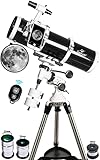
7. Gskyer 130EQ (Best for iPhone Astrophotography)
- 【Reflector Telescope】This reflector telescope is a great choice for anyone interested in exploring the night sky. Its 5.1 inch aperture and all-glass optical components with high transmission coatings allow for enhanced image brightness and clarity, making it ideal for observing the Moon, planets, brighter galaxies, nebulas, and star clusters.
- 【Toothless Focusing Base】The telescope's short 24 inch long optical tube design and fast f/5 focal ratio, along with its toothless focusing base, provide a user-friendly experience for beginners and advanced astronomers alike.
- 【Complete Parts】The included 3 eyepieces, a 3X Barlow lens, a finderscope, and an adjustable tripod make it easy to find and observe celestial objects from any viewing position.
- 【Wireless Remote Control】There is no need to download app, the remote can be paired with your device via Bluetooth, compatible with iPhone or Android device. With the bluetooth camera remote, you can take pictures or videos and share them with your family and friends in real time.
- 【Satisfaction Quality】With a 1-year warranty and lifetime maintenance, you can be confident in the quality and reliability of this telescope. If you have any questions or concerns about the product or service, the manufacturer provides helpful customer support to ensure your satisfaction.
Specifications
- Aperture: 130 mm
- Focal length: 650 mm
- Field of view: 1.5°
- Main mirror length: 609.6mm
- Finderscope: Red dot finder
- Dimensions: 32 x 18 x 8 inches
- Item Weight: 34 pounds
Gskyer’s Astromaster 130EQ telescope is the epitome of adaptability. The Astromaster 130EQ includes everything you’ll need to begin your trip among the stars, whether you’re a novice or a seasoned astronomer.
The Gskyer Astromaster 130EQ telescope has a 130mm aperture and a focal ratio of f/5. It has a total focal length of 650mm and a 130mm aperture. Furthermore, the Astromaster 130EQ comes with three distinct eyepieces in terms of optics.
A low magnification (25 mm) magnifies 40x, a medium (10 mm) magnifies 100x, and a high (5 mm) magnifies 200x.
A 3x Barlow lens, on the other hand, delivers the highest precision in a telescope.
An equatorial mount, a stainless steel tripod, and an accessory tray are all included with the AstroMaster 130EQ Professional Reflector Telescope.
Why We Recommend It
The optics of this telescope are coated with a multi-antireflection blue film which results in increased picture brightness and clarity.
The Gskyer Astromaster 130EQ is suited for both celestial and terrestrial observations because of its superior design and features.
You’ll be able to see the Moon’s oceans, Saturn’s ring, Jupiter’s moons, and follow fast-moving astronomical objects like comets using this telescope.
Pros
- Decent optics
- Comes equipped for smartphone astrophotography
- Great views of planets and bright galaxies
- Easy to set up and use
- Beginner-friendly
- Affordable
Cons
- Some may find it heavy
Fast vs Slow Telescope For Planets & Galaxies
A telescope with a long focal length is regarded as slow, whereas one with a small focal length is called a fast telescope.
Magnifications are high with slow telescopes. However, it comes at the cost of the field of view. As a result, if you’re wanting to buy a telescope to observe things such as the moon, Mars, Saturn, and other planets, and nearby galaxies, a slow telescope is an ideal option.
On the contrary. A wider field of view is achieved with shorter focal lengths. Fast telescopes are therefore ideal for seeing deep-sky objects such as nebulas, and star clusters.
Choosing a Good Mount for Observing Planets & Galaxies
The Mount is what the Optical tube is attached to and is responsible for how the user aligns, moves, and tracks celestial objects.
There are three principal types: Alt-Azimuth (AZ or Alt-Az), German Equatorial (EQ), and Computerized.
When it comes to viewing planets & galaxies German Equatorial or Computerized mount are the best options. They eliminate the loss of focus due to the earth’s rotation and track your object.
If you are not budget constrained then I highly recommend going for a good computerized mount as it can make a huge difference in viewing and photographing galaxies and planets.
Which is the Best Telescope for Viewing Planets & Galaxies
Overall, the best telescope that can be used to observe distant galaxies, as well as planets, is the Celestron NexStar 6SE.
This telescope features the Schmidt-Cassegrain design (which combines both a mirror and lens in a sealed unit) with a very long focal length, but in a much shorter tube.
This makes them very ‘slow’ and perhaps the best kind of telescope for viewing the planets and nearby galaxies.
This telescope can be used by users of all experience levels for viewing close-by objects like the moon, Mars, Saturn, etc., and deep space objects like galaxies, nebulas and star clusters.
It’s surely expensive, but thousands of positive reviews on Amazon from happy users suggest that this telescope is with the price.
Moreover, if maintained properly, it will last you a very long time.
If you’re on a budget, then I would highly recommend going for the Sky-Watcher Classic 150 Dobsonian telescope. It can show you great views of the moon, planets, and bright DSOs such as the galaxies and nebulae.
You’ll have no trouble seeing the ice caps and dark regions of Mars, the phases of Venus and Mercury, Jupiter’s moons, Great Red Spot, Saturn’s rings, the Cassini Division,
and Uranus and Neptune as bluish dots.
Which is the Best Telescope for Photographing Planets & Galaxies?
If you’re planning to use your telescope for serious astrophotography, then I will recommend that you go for Sky-Watcher ProEd 80 APO Refractor Telescope and buy a German Equatorial or Computerized mount along with it.
This telescope is a wide-field telescope that offers bright, wide swaths of sky in a single view. It is well suited for wide-field astronomical observation of prominent nebulae, star clusters, and galaxies, and it can be used for sky photography.
Which is the Best Computerized Telescope for Viewing Planets & Galaxies?
I would say both Celestron NexStar 130SLT and NexStar 6SE are great contenders for the best GoTo telescopes for observing galaxies and planets.
The NexStar 130SLT is great for stargazers on the go, as it’s compact, lightweight, and can be set up in no time, which makes this telescope one of the best portable telescopes on our list.
The Celestron NexStar 6SE is a telescope that’s an all-arounder, fit for a beginner, who is just venturing into astronomy, and for a more seasoned adult observer with excellent knowledge of the night sky.
Buying Guide: Telescope For Viewing Planets and Galaxies
The best telescope for viewing planets and galaxies has two essentials: high-quality optics and a steady, smoothly working mount. You may also want the telescope to be nice and large, but don’t forget portability and convenience.
Features To Consider When Choosing A Good Telescope To View Planets
Aperture
Aperture is the diameter, usually measured in millimeters, of the objective (primary) lens or mirror of the telescope. Essentially, the larger the aperture, the brighter images will appear, and the deeper into space you will be able to see.
Focal length
Focal length is the measurement, again in millimeters, from the objective to the eyepiece. This length directly affects the magnification potential of the telescope when paired with an eyepiece.
The distance can be a literal linear measurement from the primary lens to the eyepiece, as with a refractor; or a theoretical distance based on how the light is bounced from primary to secondary mirrors and then into the eyepieces.
This theoretical distance, used with reflectors and catadioptrics, will create a focal length that is longer than the actual optical tube—making the OTA more portable while significantly boosting the magnification potential beyond a similarly-sized refractor.
Focal ratio
Focal Ratio is a term that will be familiar to photographers, but it is important to certain astronomers, as well. This term is defined as the ratio between the focal length of the scope and the aperture.
Eyepieces
Eyepieces determine the magnification and field of view of a telescope. Different eyepieces are used to view different objects.
Some objects, such as nebulae and star clusters, appear quite large and are best viewed at low magnifications (which give a wider field of view), whereas planets appear very small and are normally viewed with high-magnification eyepieces.
Finderscope
A good finderscope is essential for any telescope. It brightens and magnifies the view, allowing you to find things beyond the naked-eye limit.
When properly aligned, a finderscope also allows you to point a telescope more precisely than do peep sights or reflex finders. This is especially important whenever you’re aiming at a blank point in the sky where your charts tell you an interesting, faint object ought to be.
Types Of Telescopes
1. Refractor Telescope
When most people think of a telescope, the refractor type is what’s going to pop into their minds. This kind of telescope uses a lens to focus light on a single mirror, which is angled to direct the light through an eyepiece into your eye.
The simplicity and reliability of the design makes it easy to use and requires little maintenance. These are excellent for observing objects, planets, the Moon and the galaxies.
Since the optical system is basically a straight line, there are no obstructions from secondary mirrors as there are in Newtonians or catadioptrics.
2. Reflector Telescope
Reflector telescopes feature a clear piece of glass or plastic at the front of the tube. These don’t warp the light, so they aren’t lenses, but instead a protective shell to keep dust out.
A mirror sits at the back of the tube. It’s curved to focus light on a second mirror, which directs light through the eyepiece and to your eye.
Reflector telescopes are easily identified by the fact that the eyepiece is found near the telescope’s front. These tend to be the least expensive, and you can get larger apertures for a lower price than with other models.
3. Compound Telescope (Catadioptrics)
Compound telescopes use an initial lens to focus light onto a mirror at the back of the telescope. The mirror focuses light onto a smaller mirror mounted on the back of the lens, which directs light through a tube that runs through the center of the first mirror and out the back of the telescope.
Compound telescopes are very lightweight relative to other types, and they don’t require collimation like reflector telescopes do.
Written by:
Chandrashekhara Rao
I grew up in a rural community with a dark sky, and that is where I learned to appreciate planets and stars at an early age. I have been fascinated with all things astronomical since I was a kid and started with a cheap-and-cheerful 60mm refractor on a wobbly tripod.
ABOUT US
We are a team of active amateur astronomers, here to help you with all your astronomy and science related needs – this is anything, from reviewing the latest telescopes to be released to talking about gravity and neurons. The Big Bang Optics was started because of our love for astronomy and to help others like us find the best telescope and accessories.
LEGAL DISCLAIMER
The Big Bang Optics is a participant in the Amazon Services LLC Associates Program, an affiliate advertising program designed to provide a means for sites to earn advertising fees by advertising and linking to Amazon.com. The Big Bang Optics also participates in affiliate programs with Clickbank and other sites. The Big Bang Optics is compensated for referring traffic and business to these companies.