7 Best Telescopes Under $250; Reviews
Disclosure: This post contains affiliate links and I may earn a small commission (at no extra cost to you) if you click through and make a purchase. Thanks in advance – I really appreciate it!
Are you looking for the best telescope under $250 and not sure where to start? Congratulations! You’ve landed on the right page.
There’s a deluge of products, prices, and features that can make buying a telescope in this price range quite overwhelming.
You don’t want to sort through dozens of models to find the one that’s right for you. Instead of doing that, check out this list of the best telescopes under $250.
Our reviews tell you the things you really need to know about each model, good and bad so that you can find one that meets your needs while avoiding problems.
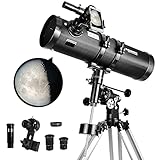
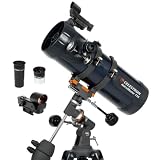
My 3 Top Picks for Less Than $250
Comparison Table
What can you see with a telescope under $250?
The telescopes that cost less than $250 typically have an aperture size ranging from 3 to 5 inches.
Since these telescopes are limited by their small aperture, they are mainly meant for viewing the moon, planets, and bright objects like double stars.
With the telescopes on this list, you’ll be able to see the phases of Venus and Mercury, lots of detail on the Moon, and perhaps the ice caps and a dark spot or two on Mars.
You can also see Jupiter’s cloud belts, the Great Red Spot, and its moons.
Saturn’s rings, a few of its moons, and some dull cloud bands can also be spotted, along with the Cassini Division in the rings on a crisp night.
Telescopes in this price range are not powerful enough to show you crisp views of the deep-sky objects.
However, you might be able to pick out the dust lanes in M82 and the Andromeda Galaxy, but everything else will remain a smudge.
You’ll be able to spot globulars as big fuzzy balls–with some hint of definition if you’re really lucky.
Open star clusters are perhaps the most impressive deep-sky targets with telescopes under $250, thanks to their high brightness and contrast.
Top Telescopes Under $250 - Reviews
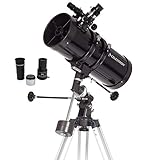
1. Celestron - PowerSeeker 127EQ
- PERFECT ENTRY-LEVEL TELESCOPE: The Celestron PowerSeeker 127EQ is an easy-to-use and powerful telescope. This 127mm Newtonian Reflector offers enough light gathering ability to see planets, the Moon's craters, distant stars, the Orion Nebula, and more.
- MANUAL GERMAN EQUATORIAL MOUNT: With its slow-motion altitude rod, the German Equatorial mount allows you to navigate the sky with ease. Find celestial objects quickly and follow them smoothly & accurately as they appear to drift across the night sky.
- COMPACT AND PORTABLE: The ideal telescope for adults and kids to use together, the PowerSeeker is compact, lightweight, and portable. Take it to your favorite campsite, a dark sky observing site, or simply the backyard.
- MULTIPLE ACCESSORIES: The Celestron PowerSeeker 127EQ Telescope comes with 2 quality eyepieces (20mm and 4mm) plus a 3x Barlow lens to triple the power of each. You'll also receive a FREE download of one of the top-rated astronomy software programs.
- UNBEATABLE WARRANTY & SUPPORT: Buy with confidence from Celestron, a leading telescope brand in California since 1960. Your purchase includes a 2-Year US Warranty and unlimited support from our team of US-based experts.
Specifications
- Type: Reflector
- Aperture: 127 mm(5)
- Focal length: 1000mm
- Focal Ratio: f/7.9
- Mount: Equatorial
- Eyepiece: 20mm, 4mm
- Magnification: 50x, 250x
- Weight: 21.38 lbs.(9.7 kg)
The 127EQ is one of the best reflector telescopes that cost under $250, it packs a good aperture and premium quality features, and it’s built to sustain some wear and tear over time.
The 127mm (5”) aperture is a good size that puts the Celestron Powerseeker 127EQ on the higher end in terms of light gathering ability, especially for the price.
The focal ratio is f/8 which is very moderate and is perfect for beginners.
It comes with a manual German equatorial mount which is definitely a solid choice if you’re looking to get smooth and accurate pointing, as a new telescope user will have the ability to swivel and move their telescope to spot star clusters in the night sky.
Why We Recommend It
What really makes this 5” affordable reflector so special is not only its sheer size but the clarity it is able to provide as well. Basically, the 127mm aperture allows you to spot distant stars, clusters, planets, satellites, and nebulas with pristine, vivid clarity.
The Celestron Powerseeker 127EQ will be able to effectively see all of the favorite sights such as the moon, Jupiter, and its moons as well as Saturn and the rings of Saturn.
In addition to all of that, at 5” in diameter, it will also be able to catch some unique glimpses of dim and distant sights beyond the solar system.
The telescope comes with two eyepieces (4mm, 20mm), a 3x Barlow lens, access to the Starry Night software, and a two-year warranty.
The Starry Night professional astronomy software suite can help beginners learn about the night sky, how objects move and where and when to see specific objects.
You can even try your hand at astrophotography with this telescope. The Celestron 127EQ is a relatively slow scope with a focal ratio of f/7.9.
A simpler way of saying the same thing is that pictures taken through it will be less distorted than with a low-f scope, especially around the edges of the field of view.
Another advantage is that a bigger f/number generally makes it easier to get an attached camera into focus.
Pros
- Large aperture
- Affordable
- Limited astrophotography
- Great for the moon, planets, and bright DSOs
- Comes with a solid mount and accessories
Cons
- Need to be regularly collimated
2. MEEZA 90mm Refractor Telescope
- Professional Astronomical Refractor Telescope: If you are interested in astronomy or like to explore the night sky, the MEEZAA astronomical telescope is for you. A perfect telescope for adults astronomy beginners to explore nature and the universe
- 90mm Large Aperture: The astronomy telescope has an 800mm(f/8.88) focal length and 90mm aperture. The 90mm aperture captures more light pictures, fully multi-coated optical glass lenses with high transmission coating improve image brightness and clarity
- Optimum Magnification (32X-240X): Our telescope for adults high powered is equipped with two eyepieces(10 mm and 25 mm) and a 3X Barlow lens. The 3X Barlow lens triples the magnification of each eyepiece, allowing us to observe unprecedented lunar details
- Convenient Accessories: Includes an adjustable stainless steel tripod (28 to 46 inches) for flexible viewing. All accessories fit neatly into the carry bag. Use the phone adapter to capture photos and videos, sharing moments. Ideal for backyard astronomy, camping nights, and outdoor star parties
- Quick Setup, Big Discoveries: With a detailed paper manual, 90% of users assemble in 10 minutes. MEEZAA telescopes are trusted by thousands for learning astronomy, exploring nature, and creating unforgettable moments under the stars
The MEEZAA 90mm Aperture 800mm Refractor Telescope is an entry-to-mid-level astronomical refractor that aims to give beginner enthusiasts a solid introduction to night-sky observing.
With its 90 mm objective lens and 800 mm focal length, it gathers a respectable amount of light for this price tier — making objects like the Moon, planets, and brighter celestial features visible with decent clarity. The optics are fully multi-coated with high-transmission coatings, which helps enhance image brightness and contrast.
This refractor comes as a complete kit rather than just an optical tube: it includes essentials like two eyepieces (10 mm and 25 mm), a 3× Barlow lens to increase magnification, a finder scope, a zenith mirror, an adjustable tripod, a smartphone adapter for digiscoping, and even a carry bag — giving beginners everything they need to start exploring immediately.
Why We Recommend It
Good light-gathering for the price: The 90 mm objective captures more light than many entry-level scopes, allowing more detail on the Moon and visible planets compared to smaller 60–70 mm scopes.
All-in-one beginner kit: Comes with key accessories (multiple eyepieces, Barlow lens, phone adapter, adjustable tripod), reducing the need for immediate extra purchases.
Multi-coated optics: Fully multi-coated lenses help improve image brightness and clarity for casual astronomy and daytime terrestrial viewing.
Smartphone adapter included: Lets beginners experiment with simple astrophotography and capture Moon or bright planet shots without extra gear.
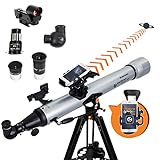
3. Celestron – StarSense Explorer LT 80AZ
- SMARTPHONE-POWERED SKY TOUR: No experience needed! Just dock your phone, launch the StarSense Explorer app, and follow the on-screen arrows to locate stars, planets, nebulae, and more.
- PATENTED STARSENSE TECHNOLOGY: Unlike other astronomy apps, StarSense Explorer uses sky recognition technology to turn your phone into a celestial navigation system, analyzing star patterns overhead to pinpoint your telescope’s position.
- TONIGHT’S BEST TARGETS, INSTANTLY: The app generates a curated list of the top objects to see based on your time and location. See planets, bright nebulae, galaxies, and star clusters from the city—and even more from dark skies.
- SIMPLE SETUP, SMOOTH TRACKING: Features a manual altazimuth mount with altitude slow motion adjustment with a sliding rod. Follow the on-screen arrows to your target; when the bullseye turns green, you can view it clearly through the eyepiece.
- 80MM REFRACTOR WITH IMPRESSIVE VIEWS: The 3" Refractor with high-reflectivity coatings delivers sharp, vivid views of the Moon, planets like Jupiter and Saturn, and deep-sky favorites like the Orion Nebula and Andromeda Galaxy.
Specifications
- Type: Refractor
- Aperture: 80mm(3.1”)
- Focal length: 900mm
- Focal Ratio: f/11
- Mount: Altazimuth Mount
- Eyepiece: 25mm,10mm
- Magnification: 36x, 90x
- Barlow lens: 2x
- Weight: 9.2 lbs. / 4.2 kg
You can travel the night sky with your smartphone using the Celestron StarSense Explorer LT 80AZ Smartphone Telescope.
The StarSense Explorer app determines your location in real-time and provides you with a menu of currently observable items to help you navigate.
Simply place your phone in the unique StarSense dock and launch the StarSense Explorer app.
To use the StarSense Explorer app, simply place your phone on the StarSense dock. StarSense Explorer generates a list of celestial objects currently visible when you set your phone to the telescope’s optics.
When you make your choice, arrows show onscreen to guide you as you move the telescope.
Dual-axis slow-motion controls on a manual alt-azimuth mount make it easy to follow arrows in-app to your target. Eyepiece viewing is ready when the app’s bullseye turns green.
Why We Recommend It
With an aperture of 3.51 inches (80 mm), this refractor is suitable for observations of the brighter members of the solar system, including the moon, Venus, Jupiter, and Saturn.
The optical system is also capable of providing closer views of brighter deep-sky targets such as the Andromeda Galaxy (Messier 31) and the Orion Nebula (Messier 42).
The Inspire 80AZ comes with a 90-degree erect image diagonal with a 1.25-inch fitting that makes the telescope suitable for terrestrial and celestial views, a pair of Kellner eyepieces (20 mm and 10 mm), an accessory tray, and a StarPointer Pro finderscope.
StarSense Explorer is ideal for beginners thanks to the app’s user-friendly interface and detailed tutorials. It’s like having your own personal tour guide of the night sky.
The sky view shown on your smartphone screen updates as you move the telescope, no cell signal is required for the telescope to do this.
Easy-to-use StarSense Explorer app creates a Tonight’s Best list, making it fast and easy to choose and look at a large selection of objects.
Pros
- StarSense explorer app is outstanding
- No color aberration
- Perfect for beginners who want to learn about the night sky
- Lightweight & portable
- Super easy to use
Cons
- Plastic mount
- Syncing the app with the phone takes 10 minutes
4. SOLOMARK 130EQ Newtonian Reflector
- 【130mm Large Aperture】Large aperture 130mm telescope, high resolution, good light collecting ability, imaging brighter, more suitable for the observation of deep space celestial objective.
- 【High Quality Optics】The telescope adopts a sturdy and light fram structure, the carbon fiber was covering on the telescope surface, sophisticated technology. Objective lens features fully-coated glass optics, it can improve the optical system performance of astronomical telescopes, help you observe brighter, more detailed planets.
- 【German Equatorial Mount】German Equatorial with dial and fine-turned control cables. Adjust rod to desired position, then easily secure by tightening knob. Precise positioning and fast tracking of celestial bodies make your observation more stable. You can enjoy the amazing process of manual tracking of the moon and planets.
- 【Stable Tripod】The telescope comes with a high-quality large diameter adjustable aluminum alloy tripod. Extra a tray is attached for storing small temporary attachment. The tripod stable structure stable enable you to Locate celestial objects smoothly and accurately.
- 【Multiple Accessories】Come with 2 High-quality Eyepieces, a 1.5X Erecting Barlow Lens, a 1.25" 13% Transmission Moon Filter, a Cellphone Adapter. The telescope contains all the accessories you need to observe. If you have any questions, please feel free to contact us, we will do our best to help you in 24 hours.
he SoloMark 130EQ Newtonian Reflector Telescope is a mid-range manual reflector aimed at astronomy enthusiasts who want more aperture and better deep-sky capability than basic beginner scopes.
With a 130 mm (≈5 in) aperture and a 650 mm focal length, this telescope gathers a good amount of light, making it capable of showing crisp views of the Moon, planets, and many brighter deep-sky objects like star clusters and nebulae. Its German equatorial mount with fine-motion controls allows for manual tracking of celestial objects as they move across the sky, which is a nice upgrade over simple alt-azimuth tripods.
The package comes with accessories to help you get started right away, including two eyepieces, a 1.5× erecting Barlow lens, a 13 % transmission moon filter, and a smartphone adapter to attach your phone for casual astrophotography. A sturdy adjustable aluminum tripod and a larger finderscope make locating targets easier and help stabilize your views.
Why We Recommend It
Large 130 mm aperture: The bigger objective mirror gathers more light than many entry-level telescopes, providing brighter and more detailed views of planets, the Moon, and many deep-sky objects.
German equatorial mount: With slow-motion cables for tracking, this mount gives smoother object tracking than basic mounts, helping you follow targets manually as the Earth rotates.
Complete accessory set: Two eyepieces, a Barlow lens, moon filter, and phone adapter make this a good starter package with more versatility than many budget scopes.
Sturdy tripod: A robust adjustable tripod helps keep the telescope stable, which is key for sharp views at higher magnifications.
5. Gskyer 80mm Refractor Telescope
- 【Ultra-clear Refracting Telescope】With 400 mm focal length and 80 mm aperture to capture more light picture and optical glass coated for enhanced image brightness to protect your eyes.
- 【Optimum Magnification】Three replaceable eyepiece (16X, 40X, 80X) with a 3X Barlow lens. 6*30 finder scope with mounting bracket, erect-image diagonal make locating objects more easily.
- 【Adjustable Tripod】This telescope allows for many different viewing positions with a adjustable tripod. Adjustable full size tripod ensures a stable platform.
- 【Applicable Use】This telescope is quick and easy to set up even for the novice and will encourage kids to love learning about space, great gift idea for kids who love science and astronomy!
- 【Satisfaction Quality】Reliable and friendly customer service within a 24 hour time frame. 1-YEAR care for free replacement.
Specifications
- Type: Refractor
- Aperture: 80mm (3.14″)
- Focal length: 400mm
- Focal Ratio: f/4
- Mount: Alt-Azimuth
- Eyepiece: 25mm, 10mm, 5mm
- Magnification: 16x, 40x, 80x
- Barlow lens: 3x
- Weight: 8.4 lbs (3.81 kg)
This is an entry-level 80 mm short focal length refractor telescope. The package includes the optical tube assembly (the telescope), a mount/tripod, three eyepieces, and a 3X Barlow lens.
The Gskyer refractor telescope also comes with a smartphone adapter so you can take photos through the eyepiece.
The lens is fully coated with optics that will protect your eyes from harmful radiation.
It features a strong magnification that brings distant astronomical objects like the moon, stars, and galaxies closer to your eyes. You can see sharp and detailed photos of heavenly objects with ease.
The long focal length also lets you photograph large landscapes or observe birds in the sky or animals on the ground.
The images provided by the included eyepieces are quite good. However, as is typical of entry-level achromatic refractors, there is a fair amount of chromatic aberration around bright objects like the moon.
Why We Recommend It
The package comes with a 48-degree correct-image diagonal that is optimized for daytime use, making the scope useful as a spotting scope for birding, boats on the water, or other daytime uses.
The scope comes with three eyepieces, 25 mm, 16x, 10 mm, 40x, and 5 mm, 80x. They are of the standard 1.25” diameter. Any brand of 1.25” eyepiece will work in this scope.
The tripod/mount of the Gskyer 80 mm is solid, stable, easy to direct, and does a good job.
There is an accessory tray provided where you can put your eyepieces when you are using the telescope.
Gskyer includes a smartphone holder with a remote trigger that will let you take pictures through the eyepiece. This should work well for daytime use and will give you nice shots of the Moon.
The telescope is equipped with a full-size adjustable tripod, so you can have your desired view from any position. The tripods can also be used by both kids and elders with its adjustable feature.
Pros
- Decent optics
- Multiple eyepieces
- Smartphone adapter included
- Good mount
- Lightweight and portable
- Multilayer coated lens
- Provides sharp and crisp views
Cons
- Not for DSOs
6. Celestron - PowerSeeker 80EQ
- PERFECT ENTRY-LEVEL TELESCOPE: The Celestron PowerSeeker 80EQ is an easy-to-use and powerful telescope. This 80mm refractor telescope offers enough light gathering ability to see planets, the Moon's craters, distant stars, the Orion Nebula, and more.
- MANUAL GERMAN EQUATORIAL MOUNT: With its slow-motion altitude rod, the German Equatorial mount allows you to navigate the sky with ease. Find celestial objects quickly and follow them smoothly & accurately as they appear to drift across the night sky.
- COMPACT AND PORTABLE: The ideal telescope for adults and kids to use together, the PowerSeeker is compact, lightweight, and portable. Take it to your favorite campsite, a dark sky observing site, or simply the backyard.
- MULTIPLE ACCESSORIES: The Celestron PowerSeeker 80EQ Telescope comes with 2 quality eyepieces (20mm and 4mm) plus a 3x Barlow lens to triple the power of each. You'll also receive a FREE download of one of the top-rated astronomy software programs.
- UNBEATABLE WARRANTY & SUPPORT: Buy with confidence from Celestron, a leading telescope brand in California since 1960. Your purchase includes a 2-Year US Warranty and unlimited support from our team of US-based experts.
Specifications
- Type: Refractor
- Aperture: 80 mm (3.15″)
- Focal length: 900mm
- Focal Ratio: f/11
- Mount: Equatorial
- Eyepiece: 20mm, 4mm
- Magnification: 45x, 225x
- Weight: 16.38 lbs (7.4 kg)
The Celestron PowerSeeker 80 EQ is an 80mm, lightweight, versatile, and durable refractor which makes it one of the best telescopes under $250.
The 80EQ has an aperture of 80mm (3.15″), and a focal length of 900mm resulting in a focal ratio of f/11.
The focal ratio of f/11 means that the chromatic aberration refractors tend to suffer from will be minimized and the views will be narrower too, making a solid scope go planetary viewing.
The 80EQ comes with a fair few accessories within such as one 1.25″ Kellner eyepieces at 20mm and another Ramsden 4mm, a PowerSeeker 3x Barlow lens, erect image diagonal, a smartphone adapter, an EQ-1 German equatorial mount, and a tripod.
The Barlow lens is a 3x magnifier. This means, that when attached to the eyepieces, you will triple the magnification potential of each.
The erect image diagonal makes it so that this telescope can be used as a terrestrial viewer as well as a sky viewer.
Why We Recommend It
This is a great telescope for beginners because it will be able to hone in and see things such as the details on the surface of the moon, the rings of Saturn, and the polar ice caps on Mars.
The focal ratio of f/11 makes it so this telescope is the best at focusing on brighter, detailed objects. That is why it is great at finding and imaging the planets, the moon, and other similar objects.
The Celestron PowerSeeker 80EQ Refractor Telescope comes with fully coated glass on every piece of its scope which also acts to cut down on aberrations of image quality.
The Celestron PowerSeeker 80EQ Refractor Telescope comes with a German equatorial mount and standard tripod base.
The German equatorial mount allows you to align the telescope with the equator which makes it easy to keep objects in the eyepiece for hours, even all night if you want to.
The mount is sturdy and responsive. The knobs are smooth and fluid to use.
Pros
- Decent optics for the price
- Many accessories provided
- Decent mount
- Minimal maintenance required
Cons
- Not very powerful
7. Celestron - AstroMaster 114EQ
- POWERFUL TELESCOPE FOR ASTRONOMY BEGINNERS: The AstroMaster 114EQ delivers sharp optics, a stable equatorial mount, and smooth manual controls, making it the top choice for beginners ready to explore the night sky.
- HIGH-QUALITY 114MM OPTICS: Enjoy views through the 114mm (4.5”) Newtonian reflector, which features high-quality aluminum and SiO₂ coatings and enough light-gathering ability to view all the best celestial objects.
- SMOOTH, ACCURATE POINTING: Effortlessly aim and center your target using the two slow-motion control knobs for right ascension and declination whether you’re observing planets or deep-sky objects.
- QUICK SETUP: With just a few key parts to assemble, you can go from box to backyard in minutes—no tools required. The sturdy, adjustable tripod provides stable, comfortable viewing tailored to your height, perfect for adults or kids, standing or seated.
- INCLUDED ACCESSORIES: 20mm eyepiece with built-in erect image corrector, 10mm eyepiece, and a StarPointer red dot finderscope. You'll also receive a FREE download of one of the top-rated astronomy software programs.

Specifications
- Type: Newtonian reflector
- Aperture: 114mm (4.49″)
- Focal length: 1000mm
- Focal Ratio: f/9
- Mount: Equatorial
- Eyepiece: 20mm, 10mm
- Magnification: 50x, 100x
- Weight: 17 lbs (7.71 kg)
The Celestron AstroMaster 114 EQ reflector telescope costs less than 250 dollars and is a great beginner telescope for an adult or a teenager.
It features all-glass optical elements, smooth operating steel tripod mountings with manual motion controls, and coated optics for enhanced image brightness and clarity.
It’s all anchored by a rugged, pre-assembled tripod with 1.25-inch steel tube legs, providing a rigid and stable platform.
The optical quality, when calibrated properly, is very good for the price point. With a 114mm primary aperture and a focal ratio of f/8.6, this is a tremendous all-around reflector.
The optics on this telescope are not very powerful, but they will be able to do a lot, especially for someone just starting.
It does not have the steadiest of the mounts and the tripod too is a bit shaky. The biggest issue this telescope has is the need for frequent collimation. Collimation is the calibration of the mirrors in the telescope to make sure that they are in alignment.
Why We Recommend It
The AstroMaster equatorial mount is easy to set up and requires no tools to do so. Unlike a simple alt-azimuth mount, an equatorial mount will allow your telescope to track objects as they move across the sky throughout the night.
The optics on this reflector are going to be great for looking at the moon, planets such as Jupiter and Saturn, as well as some deep space objects like Andromeda or nebulas far away.
With the package, you’ll receive a fairly competent set of accessories from a 1.25” rack-and-pinion focuser, a StarPointer red-dot finderscope, and 2 1.25″ eyepieces at 20mm and 10mm along with SkyX First Light Edition planetarium software CD.
This telescope is certainly not perfect. It has a few issues that arise from its basic design.
For the money, though, this telescope offers a wide optical range and may be used for a variety of night sky views.
It can also help you learn a lot. A newbie may surely learn a lot using this telescope, from collimation to good tripod setup and long observing session tracking.
Pros
- Easy to set up and use
- Versatile telescope
- Has a decent amount of power and focus
- Portable
- Affordable
Cons
- Mediocre accessories
- Unstable tripod and mount
- Requires frequent collimation
Choosing the Best Telescope Under $250; Buying Guide
Don’t let the pages and pages of telescopes turn you off or lure you into a bad purchase. Trust our knowledge and expertise to lead you to brands and bargains that will not disappoint.
As you compare the telescopes above – as well as any others you’re considering – keep in mind the following:
1. Telescope Types
There are three primary types of telescopes:
Refractor Telescopes – Refractors use a glass lens as their primary method of gathering and focusing light. When you combine the lens with an eyepiece, you are able to magnify the image for better viewing.
Reflector Telescopes – Reflectors use mirrors instead of a lens to gather and focus light. The light enters through a wide opening, and then a mirror redirects the light back towards the opening before it’s redirected to the eyepiece using another mirror.
Catadioptric Telescopes – Compound telescopes use an initial lens to focus light onto a mirror at the back of the telescope. The mirror focuses light onto a smaller mirror mounted on the back of the lens, which directs light through a tube that runs through the center of the first mirror and out the back of the telescope.
2. Aperture
The aperture is the diameter of the primary mirror in a reflector or the objective lens in a refractor.
The bigger the aperture, the more light the telescope lets in. More light means you can get more detail at the same magnification, and that you can increase the magnification without losing too much detail.
It also means you’ll be able to see more distant objects. If you want to look at other planets in our solar system, such as Mars, Saturn, or Jupiter, you’ll probably want a telescope with at least a 100-millimeter lens.
3. Focal Length
Focal length is the distance between the lens/mirror and the point where the object is brought into focus. Essentially, this length communicates how much magnifying power your telescope has.
4. Mounts
You’ll have two types of mounts available to you in this price range. Alt-azimuth & equatorial.
Alt-Azimuth – Alt-azimuth mounts are very simple to understand and use. Azimuth is horizontal movement and allows the scope to be moved in the left-right direction.
This is the simplest and easiest-to-use mount for beginners because it works the way you would expect, similar to a camera tripod. To use it, you simply point it where you want to look and tighten it down.
Equatorial – Equatorial mounts are like alt-az mounts, but they have an axis that is on a tilt. The tilt allows the scope to be polar aligned to the North celestial pole.
The Dec (Declination) axle must have counterweights to support the tube. The Dec axis allows the scope to be moved North and South while the RA (Right Ascension) axis allows the scope to be moved East and West.
5. Eyepieces
An eyepiece uses the light gathered and focused to magnify objects and generate images. Most models include one, or two eyepieces with one optimized for wider field views and the other for higher magnification.
The focal length of both the telescope and the eyepiece influences the level of magnification. To calculate eyepiece magnification, divide the telescope focal length by the eyepiece focal length.
Conclusion
Overall, these were some of the best telescopes under 250 dollars that are available right now. Each astronomer will have their own opinion, and these are just a few of my favorites. Feel free to explore the website and check out some of the other telescopes that I think are worth considering as well.
Ultimately, I am confident you’ll find something in this price range that will be a great fit – so, now it’s up to you to pick one and get started!
Written by:
Chandrashekhara Rao
I grew up in a rural community with a dark sky, and that is where I learned to appreciate planets and stars at an early age. I have been fascinated with all things astronomical since I was a kid and started with a cheap-and-cheerful 60mm refractor on a wobbly tripod.
ABOUT US
We are a team of active amateur astronomers, here to help you with all your astronomy and science related needs – this is anything, from reviewing the latest telescopes to be released to talking about gravity and neurons. The Big Bang Optics was started because of our love for astronomy and to help others like us find the best telescope and accessories.
LEGAL DISCLAIMER
The Big Bang Optics is a participant in the Amazon Services LLC Associates Program, an affiliate advertising program designed to provide a means for sites to earn advertising fees by advertising and linking to Amazon.com. The Big Bang Optics also participates in affiliate programs with Clickbank and other sites. The Big Bang Optics is compensated for referring traffic and business to these companies.