7 Best Telescopes Under $400 In 2026: Reviews
Disclosure: This post contains affiliate links and I may earn a small commission (at no extra cost to you) if you click through and make a purchase. Thanks in advance – I really appreciate it!
Looking for the best telescopes under $400? This article has got you covered. In this article, I will review a range of quality telescopes, all of which will give you the stargazing experience you want, without draining the bank account.
The best thing about the budget of 400 dollars for a telescope is that this price range filters out a lot of the junk scopes that come with questionable spec and feature pairings, spherical mirrors on fast Newtonians, and single element lenses.
All that should have been left behind in the lower price ranges.
This price range is considered the high-end of the entry-level market. You can expect a little more of everything from quality parts and components to better visibility on objects
So, here are a few of the best telescopes you can find out there that cost less than $400.
Best Telescope Under $400
Top 3 Picks
Top Telescopes for Under $400 - Reviews
1. Celestron - AstroMaster 130EQ
- POWERFUL TELESCOPE FOR ASTRONOMY BEGINNERS: The AstroMaster 130EQ delivers sharp optics, a stable equatorial mount, and smooth manual controls, making it the top choice for beginners ready to explore the night sky.
- HIGH-QUALITY 130MM OPTICS: Enjoy views through the 130mm (5”) Newtonian reflector, which features high-quality aluminum and SiO₂ coatings and enough light-gathering ability to view all the best celestial objects.
- SMOOTH, ACCURATE POINTING: Effortlessly aim and center your target using the two slow-motion control knobs for right ascension and declination whether you’re observing planets or deep-sky objects.
- QUICK SETUP: With just a few key parts to assemble, you can go from box to backyard in minutes—no tools required. The sturdy, adjustable tripod provides stable, comfortable viewing tailored to your height, perfect for adults or kids, standing or seated.
- INCLUDED ACCESSORIES: 20mm eyepiece with built-in erect image corrector, 10mm eyepiece, and a StarPointer red dot finderscope. You'll also receive a FREE download of one of the top-rated astronomy software programs.
Specifications
- Type: Reflector
- Aperture: 130 mm(5.1″)
- Focal length: 650mm
- Focal Ratio: f/5
- Mount: Equatorial
- Eyepiece: 20mm, 10mm
- Magnification: 33x, 65x
- Weight: 28.0 lbs.(12.7 kg)
The Celestron – AstroMaster 130EQ’s large 5.11” primary aperture and f/5 focal ratio are perfect for deep space viewing. The size and design of this scope give it 345x more light-gathering ability over the naked human eye.
The AstroMaster 130EQ package includes the optical tube assembly (OTA), a CG-3 equatorial mount, and two eyepieces – 20mm and 10mm – which work with the optical system to provide magnifications and 33x and 65x, red-dot finderscope and a sturdy stainless steel tripod.
This mount is made of solid steel, so it’s built to stand up to years of regular use. It provides simple controls that even a complete beginner will be able to pick up quickly.
It also comes with a copy of the Starry Night software, which offers an impressive database of over 10,000 objects. This software is a useful supplement for learning more about the objects in the sky.
Why We Recommend It
The 5.11-inch aperture of this scope is a decent size for a telescope that costs under $400, giving the user sufficient light grasp and resolving power at their disposal to get good views of the popular targets – the Moon’s craters, Jupiter’s atmospheric belts, Saturn’s rings, the bright wisps of the Andromeda Galaxy, the Pleiades, the Orion Nebula, and the Great Hercules Cluster.
Getting started with the AstroMaster 130mm couldn’t be easier. Setting up the telescope is a breeze, and you’ll be ready to observe in just a few minutes once everything is out of the box.
The scope is relatively lightweight, especially when the OTA is separate from the mount. Newtonians are easy to transport in general, and that’s true of this scope, too.
Although this telescope is not meant for professional astrophotography, you can still use it to shoot short-exposure images of the Moon, bright planets, and more luminous deep-sky targets using a CCD style camera or your smartphone.
Pros
- Large aperture
- Equatorial mount
- Lightweight & portable
- Easy to set up & use
- Decent optics
Cons
- Mediocre accessories
- Regular maintenance required
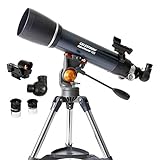
2. Celestron - AstroMaster 102AZ
- POWERFUL TELESCOPE FOR BEGINNERS: The AstroMaster 102AZ is the perfect entry-level telescope for adults and kids eager to explore the night sky. You get bright, clear views and simple, intuitive operation.
- HIGH-QUALITY 102MM OPTICS: Enjoy crisp, detailed views through the fully coated 102mm (4") short-tube refractor, offering a wide field of view ideal for scanning star fields, bright star clusters, and even terrestrial landmarks.
- VERSATILE DAY & NIGHT USE: Designed for both astronomical and land-based viewing, the AstroMaster 70AZ lets you explore the stars at night and enjoy daytime views of wildlife or distant landmarks.
- EASY-TO-USE ALT-AZIMUTH MOUNT: Smoothly navigate the sky with a manual alt-azimuth mount and easy-to-use panhandle, which lets you point the telescope up, down, and side to side with precision.
- QUICK SETUP: With just a few key parts to assemble, you can go from box to backyard in minutes — no tools required. The sturdy, adjustable tripod provides stable, comfortable viewing tailored to your height, whether you’re standing or seated.
Specifications
- Aperture: 102mm (4″)
- Focal length: 660mm
- Focal Ratio: f/6.5
- Mount: Alt-az
- Eyepiece: 20mm, 10mm
- 2x Barlow lens
- Magnification: 33x, 66x
- Weight: 14.1 lbs. (6.4kg)
The Celestron AstroMaster 102AZ offers a generous 660mm focal length and an Altazimuth mount.
Included in the box is a pair of eyepieces – 10mm, providing for 66x magnification, plus 20mm for 33x magnification – as well as a red dot finder scope for pinpointing subjects more accurately.
Thanks to the AstroMaster’s erect image optics, you get a dual-purpose telescope that is perfect for viewing terrestrial landscapes and wildlife, in addition to observing the heavens.
The instrument is the ideal size if you are looking for an entry-level telescope that is relatively lightweight and portable but still has sufficient power for viewing deep-sky objects.
The AstroMaster 102AZ is a refractor that is well-constructed; resistant to shocks and bumps and requires little maintenance apart from using and storing it correctly.
The Celestron AstroMaster 102AZ package also includes the Starry Night computer software. It allows you to connect the telescope to a computer and conveniently track and plan your observations.
As an added bonus you can access valuable information on 10 000 celestial objects.
Why We Recommend It
Thanks to the long optical tube, AstroMaster 102AZ is able to provide incredibly detailed Solar System visuals. Jupiter’s cloud storms, The Great Red Spot, and 4 Galilean Moons are easily noticeable. The Rings of Saturn are distinguishable from the planet, and Titan is visible with a good eyepiece.
The AstroMaster 102AZ really shines at producing crisp views of the Moon.
Moreover, you can catch a glimpse of most, bright deep space objects such as the Pleiades Star Cluster, Orion Nebula, and Andromeda Galaxy.
The included 90° diagonal sports an integrated erecting prism to correct images and allow the scope to be used as a conventional spotting scope for terrestrial use.
An adjustable-height stainless steel tripod supports the mount and optical tube and comes with a center tray that conveniently holds accessories while improving stability and reducing vibrations.
Read Celestron AstroMaster 102AZ Full Review
Pros
- Can also be used as a terrestrial scope
- Great high quality coated optics
- Portable and lightweight
- Fast and simple setup
- Decent deep-sky performance
Cons
- Mount could be better
- Not for astrophotography
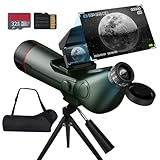
3. FASHIONARI Professional Auto-Focus Refractor Telescope
- Exceptional Optical Performance:Equipped with a powerful 80mm aperture and 300mm focal length (f/8.89), this telescope for adults delivers crystal-clear, bright views. The starlight-grade sensor supports up to 350X magnification for long-distance viewing and captures stunning 4K high-resolution images. even in low-light or moon-viewing conditions.
- Dual-Screen Display for Real-Time Viewing: This scope is equipped with not only an eyepiece with adjustable vision compensation (diopter adjustment range +/-4), but also a foldable external screen allows for direct, vivid observation. The built-in sunshade ensures clear visibility even under strong daylight, offering an intuitive viewing experience.
- One-Touch Switch Photo & Video Modes: Capture breathtaking photos or videos at the touch of a button—no external devices needed. Supports up to 512GB external storage, so you can save and share your favorite celestial moments anytime.
- Extended Battery Life & Auto Power-Off: Features a built-in 4500mAh high-capacity battery offering up to 6 hours of operation on a full charge. With customizable auto shut-off options (1/3/5/10 minutes), you can preserve battery life effortlessly.
- Versatile Use & Perfect Gift: Spotting Scope with Tripod for Target Shooting. Ideal for moon observation, stargazing, long-distance photography, and birdwatching. A perfect gift for astronomy enthusiasts and nature lovers alike.
The Professional Auto-Focus Refractor Telescope is a beginner-friendly optical telescope designed to give new stargazers a satisfying view of the night sky without the complexity of advanced gear. With a refractor design and a relatively large objective lens, it gathers enough light to deliver bright views of the Moon, planets, and brighter objects in the sky.
This model is marketed with auto-focus capability, making it easier for users to quickly bring celestial features into sharp view — a helpful boost for beginners who often struggle with manual focus on cheaper scopes. Accessories such as multiple eyepieces, a stable tripod, and sometimes a smartphone adapter are typically included, giving you a complete observing kit out of the box.
Build quality and performance appear to be comparable to other beginner telescopes in its price range, striking a balance between ease of use and observing capability. Many users find it a fun, approachable instrument for starting out with astronomy, especially if your main targets are the Moon and planets.
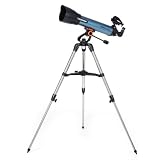
4. Celestron Inspire 100AZ
- Easiest setup of any entry level scope. With the folding accessory tray you just pop the tripod legs open, turn the lock knob and you’re ready to go.
- Bold new design - The main telescope lens cap comes with a fully integrated smartphone adapter built-in, perfect for the budding astrophotography.
- Red LED flashlight - Stowed in the center of the mount head, the flashlight can be used to gently illuminate the accessory tray or can be removed for use as a spotlight when needed.
- Focus micrometer - Allows quick return to a specific focus point for specific targets (bird nests, infinity focus, etc.)
- The asymmetrical mount design offers light weight and incredible stability. Erect image optics enables a fully correct image for easy viewing day or night, terrestrial or astronomical.
Specifications
- Type: Refractor
- Aperture: 100mm(3.9″)
- Focal length: 660mm
- Focal Ratio: f/6.6
- Mount: Manual; Alt-Azimuth
- Eyepiece: 20mm, 10mm
- Magnification: 33x, 66x
- Weight: 20 lbs.
The Celestron Inspire 100AZ offers a complete observing package with a good-sized aperture, a focal length of 660mm, and plenty of features at a reasonable cost of less than $400.
The 100mm-wide alloy optical tube is finished in a light metallic blue gloss paint with black plastic fittings and an orange, Vixen-style dovetail bar.
It also includes 20mm and 10mm Kellner eyepieces, as well as a 90° erect image diagonal, making it suitable for terrestrial observations. A helpful red light LED torch, accessory tray/leg spreader, and a dual-purpose dust cap are also included in the package.
The achromatic doublet lens is fully coated. It’s only a thin coating, but it’s evenly applied with no bad spots.
Why We Recommend It
The telescope provides great visuals of the moon and large planets and the images can also be captured with a smartphone thanks to its built-in smartphone adapter.
Planets and their brightest features can be seen clearly thanks to its 100 mm aperture. It has enough light-gathering ability and focal ratio to see distant objects such as nebula, galaxies, and star clusters.
The mount is a free-form altazimuth mount that moves very smoothly and has functional settings that allow you to cruise around the night sky with fluid ease or hone in a specific spot with the same amount of precision.
Moreover, the telescope can be assembled in minutes without tools. Everything unfolds and hooks together without having to deal with small screws or specific tools.
This telescope also features fully coated glass optics which decreases potential anomalies in the viewing and increases image quality.
Pros
- Large aperture
- Can be used as a terrestrial telescope
- Comes with a built-in smartphone adapter
- Doesn’t require regular maintenance
Cons
- Plastic mount
- Some chromatic aberration
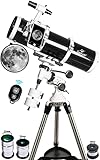
5. MEEZAA 150EQ Reflector Telescope
- 150mm Large Aperture: This astronomical reflector telescope for adults features a 650mm focal length and 150mm aperture, delivering excellent light-gathering power for bright, clear images. Ideal for deep space observation, planets, and the Moon in stunning detail
- High Magnification & Clear Optics: Equipped with two eyepieces (25mm & 10mm) and a 2X Barlow lens, this telescope for astronomy beginners offers magnification from 26X to 130X. The red dot finderscope ensures fast targeting, while the moon filter reduces glare for comfortable lunar viewing
- Stable German Equatorial Mount: Upgraded Equatorial mount with precision dials and slow-motion control knobs provides smooth pointing and accurate manual tracking. Follow the Moon, planets, and stars across the sky with ease, perfect for beginners learning astronomy and advanced stargazers
- Sturdy Tripod & Carry Bag: Heavy-duty stainless steel tripod with adjustable height ensures stable viewing. A built-in accessory tray keeps eyepieces organized. All parts, including the telescope tube, fit into the carry bag for convenient storage and travel
- Complete Accessories & Easy Setup: Includes telescope tube, Equatorial mount, tripod, 2 eyepieces, 2X Barlow lens, red dot finderscope, moon filter, phone adapter, carry bag, and instructions. No tools needed, quick to assemble. Perfect telescope for adults, astronomy beginners, and families to enjoy stargazing together
he MEEZAA 150EQ Newtonian Reflector Telescope is a powerful, beginner-friendly reflector designed for serious skywatchers who want big aperture performance without a huge price tag.
With a 150 mm (≈6″) primary mirror, it gathers significantly more light than many entry-level telescopes — meaning brighter, clearer views of the Moon, planets, and many brighter deep-sky objects like open star clusters and nebulae.
This telescope comes as a complete observing kit, including two eyepieces (25 mm and 10 mm), a 2× Barlow lens, a red-dot finderscope, a moon filter to reduce glare during lunar viewing, and a smartphone adapter so you can capture casual shots through your phone.
All components mount on a German equatorial mount with slow-motion control knobs, which helps you track celestial objects smoothly as they drift across the sky — a great feature for learning real observing techniques.
The adjustable stainless-steel tripod provides a stable platform for viewing, and the included carry bag makes transport and storage much easier. Whether you’re scanning the craters on the Moon or trying to resolve detail in Jupiter’s belts or Saturn’s rings, this telescope delivers solid performance for its class.
6. Celestron – StarSense Explorer LT 114AZ
- SMARTPHONE-POWERED SKY TOUR: No experience needed! Just dock your phone, launch the StarSense Explorer app, and follow the on-screen arrows to locate stars, planets, nebulae, and more.
- PATENTED STARSENSE TECHNOLOGY: Unlike other astronomy apps, StarSense Explorer uses sky recognition technology to turn your phone into a celestial navigation system, analyzing star patterns overhead to pinpoint your telescope’s position.
- TONIGHT’S BEST TARGETS, INSTANTLY: The app generates a curated list of the top objects to see based on your time and location. See planets, bright nebulae, galaxies, and star clusters from the city—and even more from dark skies.
- SIMPLE SETUP, SMOOTH TRACKING: Features a manual altazimuth mount with altitude slow motion adjustment with a sliding rod. Follow the on-screen arrows to your target; when the bullseye turns green, you can view it clearly through the eyepiece.
- 114MM REFLECTOR WITH IMPRESSIVE VIEWS: The 4.5" Newtonian reflector with high-reflectivity coatings delivers sharp, vivid views of the Moon, planets like Jupiter and Saturn, and deep-sky favorites like the Orion Nebula and Andromeda Galaxy.
Specifications
- Type: Refractor
- Aperture: 114mm (4.49″)
- Focal length: 1000mm
- Focal Ratio: f/9
- Mount: Alt-azimuth
- Eyepiece: Plossl 25mm, 10mm
- Barlow lens: 2x
- Magnification: 40x, 100x
- Weight: 10.4 lbs (4.71 kg)
The Celestron – StarSense Explorer LT 114AZ is perfect for novices and beginners as it allows your smartphone to be used interactively with your telescope to make it much easier to find planets, galaxies, and other objects to look at. This helps remove much of the frustration that can occur when starting with astronomy.
Explorer LT’s simple altazimuth mount makes it easy to move the telescope to find your target. A slow-motion altitude adjustment knob helps you fine-tune the telescope’s pointing position and follow targets as they appear to drift across the night sky.
Finding objects has never been easier, faster, or more accurate than with StarSense Explorer app that comes with this telescope.
To use the StarSense Explorer app, simply place your phone on the StarSense dock. StarSense Explorer generates a list of celestial objects currently visible when you position your phone to the telescope’s optics (a 10-minute procedure). When you make your choice, arrows show onscreen to guide you as you move the telescope.
Why We Recommend It
This telescope has a huge 114mm (4.5″) objective lens that can gather enough light to bring out detail in celestial objects. Jupiter’s four Galilean moons, cloud bands, and Great Red Spot will be visible, as will Saturn’s rings, the trapezium in the Orion Nebula, and the lovely Pleiades Open Star Cluster.
The package includes 25mm and 10mm eyepieces, 2x Barlow Lens, StarSense smartphone dock, a red dot finderscope (in case you want to use the telescope without your phone), and a full-height tripod.
The StarSense Explorer LT 114 mm Reflector Telescope is priced at under $400 and it is a great scope for those just getting their feet wet in the world of astronomy.
Placing your StarSense Explore app-enabled smartphone in the specially designed dock, it will analyze the night sky and calculate celestial object positions in real-time.
Pros
- The StarSense Explorer app is excellent
- Removes all the frustration of finding an object in the night sky
- Decent optics
- Smooth mount
- Great educational tool
Cons
- Vulnerable to light pollution
- Takes some time to sync with the smartphone
7. Gskyer 130EQ Professional Reflector Telescope
- 【Reflector Telescope】This reflector telescope is a great choice for anyone interested in exploring the night sky. Its 5.1 inch aperture and all-glass optical components with high transmission coatings allow for enhanced image brightness and clarity, making it ideal for observing the Moon, planets, brighter galaxies, nebulas, and star clusters.
- 【Toothless Focusing Base】The telescope's short 24 inch long optical tube design and fast f/5 focal ratio, along with its toothless focusing base, provide a user-friendly experience for beginners and advanced astronomers alike.
- 【Complete Parts】The included 3 eyepieces, a 3X Barlow lens, a finderscope, and an adjustable tripod make it easy to find and observe celestial objects from any viewing position.
- 【Wireless Remote Control】There is no need to download app, the remote can be paired with your device via Bluetooth, compatible with iPhone or Android device. With the bluetooth camera remote, you can take pictures or videos and share them with your family and friends in real time.
- 【Satisfaction Quality】With a 1-year warranty and lifetime maintenance, you can be confident in the quality and reliability of this telescope. If you have any questions or concerns about the product or service, the manufacturer provides helpful customer support to ensure your satisfaction.
The Gskyer 130EQ is a manual Newtonian reflector telescope designed to offer serious observing power at an accessible price, making it a popular choice for beginners and intermediate stargazers. Its 130 mm (5.1″) primary mirror gathers a significant amount of light, allowing crisp, bright views of the Moon, planets, star clusters, and many brighter deep-sky objects.
Mounted on a German equatorial (EQ) mount, the telescope is capable of smoother tracking of celestial objects across the sky once aligned — a useful feature for beginners who want to learn real astronomy techniques. The optical tube and accessories come with multiple eyepieces, a Barlow lens, a reflex finderscope, and an adjustable tripod to get you started right away.
While not computerized, the Gskyer 130EQ is built with solid all-glass optics and a user-friendly focuser, giving good performance for its class. Many observers find it delivers good detail on lunar and planetary features as well as satisfying views of star clusters and brighter nebulae.
What to Look for in a Telescope for Under $400
Even though you’re looking for a telescope that won’t break your budget, you still want to get the best one you can for the money you have to spend. Below you will find a list of things that are important to know before you begin shopping for a telescope
1. Types of Telescopes
There are mainly three types of telescope: Refractors, Reflectors & Compound telescopes.
Reflector telescopes use a mirror. This mirror is placed at the back of your telescope, and it reflects your images.
These tend to be less expensive than the other types of telescopes, however, they do require more maintenance.
Refractor telescopes work via a lens that is situated at the front of the telescope. Refractor telescopes are easier to maintain than reflector telescopes, however, the cost of the telescope can be quite pricey depending on the size of the lens.
The larger the lends, the better the quality, and thus, the pricier the telescope.
Compound telescopes use mirrors and lenses to gather the light for your images. They are usually smaller in size and pretty lightweight, so they are easily transportable.
2. Aperture
Aperture refers to the diameter of a telescope’s main lens or mirror. The quality of a telescope is defined by its aperture’s light-gathering ability, focal length, and its eyepiece’s magnification power.
The aperture of a telescope also determines the maximum limit of your telescope’s magnification. The larger the aperture, the higher magnification it can accommodate.
3. Focal length
The focal length is the distance between the point where the object is brought into focus and the primary lens or mirror. The focal length tells you how much magnification your telescope is capable of.
4. Focal Ratio
One thing you may hear quite a bit, especially when looking at the best telescopes for under $400, is the focal ratio. It’s not as complicated as it looks, it just calculates the speed of the aperture. This number tends to be made up of a division of the focal length by the aperture.
5. Mounts
A sturdy and stable mount provides support for your telescope, allows smooth mobility, and dampens vibrations to keep it steady for objects to stay in view. It also helps locate and track celestial objects.
Alt-azimuth and equatorial are the two most common types of mounts.
The Alt-az mount moves along two axes w/ vertical and horizontal motions. This is the simplest and easiest-to-use mount for beginner telescopes because it works the way you would expect, similar to a camera tripod. To use it, you simply point it where you want to look and tighten it down.
An Equatorial mount features two axes, with one aligning to the sky for smooth tracking of objects, an important requirement in astrophotography. The setting circles allow you to locate known objects using coordinates.
If you’ll be viewing one object for an extended period of time, this type of mount is the one you’ll need.
This is due to the fact that you’ll only really need to adjust one axis for the duration, and that axis is actually based on the rotation of the Earth.
6. Finderscope
A finderscope attaches to the outside of your telescope to help you find what you are looking for without any magnification. Some have red dot technology that will project a red dot into the sky, so you can see where your telescope is pointed with the naked eye.
7. Eyepieces
An eyepiece is the part of the telescope that you look through. There are many different types and sizes of eyepieces.
If you’re just getting started, we recommend purchasing a telescope with a few different eyepiece possibilities.
These, combined with a Barlow lens, will give you a good opportunity to be creative and explore all of your possibilities.
8. Stable Tripod
Tripods for telescopes also need to be particularly sturdy. You will want to ensure that the tripod you opt for can be adjusted to suit your height.
Also, if you plan on traveling with your telescope, you will need to ensure that the tripod can be folded down and comes with a case.
Conclusion
That concludes our discussion on the “Best Telescopes Under $400”. I hope this article has been of value to you and has provided you with everything you need to make an informed purchase.
With a decent budget of $400, you’re starting to get in range of some excellent telescopes that will give you years of wonderful viewing experiences.
If you’re looking to maximize power, Celestron – AstroMaster 130EQ pick is a solid choice as it gives you a huge aperture in a practical, versatile, affordable overall design. But, be sure to check out the other options as well, for a variety of other needs and priorities.
Written by:
Chandrashekhara Rao
I grew up in a rural community with a dark sky, and that is where I learned to appreciate planets and stars at an early age. I have been fascinated with all things astronomical since I was a kid and started with a cheap-and-cheerful 60mm refractor on a wobbly tripod.
ABOUT US
We are a team of active amateur astronomers, here to help you with all your astronomy and science related needs – this is anything, from reviewing the latest telescopes to be released to talking about gravity and neurons. The Big Bang Optics was started because of our love for astronomy and to help others like us find the best telescope and accessories.
LEGAL DISCLAIMER
The Big Bang Optics is a participant in the Amazon Services LLC Associates Program, an affiliate advertising program designed to provide a means for sites to earn advertising fees by advertising and linking to Amazon.com. The Big Bang Optics also participates in affiliate programs with Clickbank and other sites. The Big Bang Optics is compensated for referring traffic and business to these companies.