7 Best Small Telescopes 2026; Reviews
Disclosure: This post contains affiliate links and I may earn a small commission (at no extra cost to you) if you click through and make a purchase. Thanks in advance – I really appreciate it!
To ensure we can provide you with all the information about the best small telescope, we spent multiple hours researching and going through customer’s reviews and specifications.
We came out with 7 great products which have been assembled in the table below. We also wrote detailed reviews of each product to get full insight. Below it is the buying guide we crafted so that you know precisely what to look for and where to look.
Our Top 3 Picks
Best Small Telescope
With so many models with so many features available today, it can be a tedious task to find the best small telescope. We have analyzed the main features ( aperture, focal length, ratio, portability, affordability etc.) that make a good compact telescope that you can use to enjoy the night sky and fulfill your love for astronomy.
1. Celestron Travel Scope 70DX Portable Refractor Telescope
- BRIGHT, SHARP VIEWS ANYWHERE: Unlike many beginner telescopes, this quality refractor features fully coated glass lenses and a 70mm aperture for crisp, clear views of the Moon, planets, and daytime scenery—all in a lightweight, travel-ready design.
- PERFECT FIRST TELESCOPE FOR BEGINNERS: Designed for adults and kids to enjoy together, this beginner-friendly telescope sets up in minutes and delivers rewarding views with no prior experience required.
- EASY NO-TOOL SETUP: No complicated assembly or tools needed. The full-height tripod and telescope tube set up in seconds and pack neatly into the included backpack—so you’re always ready to observe on the go.
- DUAL EYEPIECES FOR VERSATILE VIEWS: Includes 20mm and 10mm eyepieces for wide and close-up views of celestial and terrestrial targets. Spot craters on the Moon at night or wildlife during the day.
- BACKPACK AND SOFTWARE: Includes a padded backpack with room for accessories, a finderscope, star diagonal, eyepieces, and a free download of Starry Night software to help you identify celestial objects and plan your next stargazing session.
The Celestron Travel Scope 70DX Portable Refractor Telescope sets itself apart as a highly versatile and travel-ready telescope that’s perfect for beginners and casual stargazers. With a 70 mm fully-coated glass optical system, it delivers crisp, clear views of the Moon, planets, and even terrestrial targets during the day — a noticeable improvement over many toy-grade scopes in its class.
Unlike basic starter telescopes, this model includes two eyepieces, a 2× Barlow lens to boost magnification, and a Moon filter that reduces glare, making lunar details easier to observe.
One of the biggest advantages of the Travel Scope 70DX is its ease of use and portability. The telescope assembles quickly without tools and is mounted on a stable alt-azimuth tripod, which simplifies tracking objects across the sky — a welcome feature for users new to astronomy. It also includes a padded backpack to keep everything together and easy to carry for outdoor trips, camping, or travel.
The fact that it comes with a smartphone adapter and Bluetooth remote adds real practical value, letting you capture images and video through the eyepiece with relative ease.
That said, while this scope packs a lot into a compact package, it’s still best suited for beginners or hobbyists rather than advanced astronomers. The 70 mm aperture isn’t large enough to reveal deep-sky wonders like nebulae with high detail, and some users note that fine adjustments can be a bit tricky until you’ve practiced a few sessions.
Still, for the price point, its combination of accessories, solid optics, and portability makes it an excellent first telescope for anyone who wants to explore the night sky without a steep learning curve.
2. ToyerBee Telescope for Adults & Kids
- High Magnification: The telescope equipped with 2 eyepieces(H20mm and H6mm) and a 3X Barlow lens. The 3x Barlow lens trebles the magnifying power of each eyepiece, so kids can get magnification from 15X to 150X. Whether it's viewing planets or moon, our telescope is the best helper for adults & kids. It’s a great telescope for adults & kids 8-12 & astronomy beginners.
- 70mm Large Aperture: The refractor telescope is equipped with a large 70mm objective lens and the lens is fully coated with high transmission coatings. The high transmission optics lens can increase light transmittance and reduce the reflection of light. The bigger the aperture is, the bigger the field of vision will be, so you can see the clearer and brighter images. Professional astromomy telescope can help adults & 8-12 kids view the planets and stars more easily.
- Wireless Remote & Phone Adapter: Our telescope is equipped with a wireless remote and phone adapter. Just install your mobile phone on the phone adapter, connect to the the eyepieces of the telescope, and use the wireless remote to take the photos. You can take clear and bright pictures easily.
- Easy to Assemble and Use: The telescope is easy to assemble even for astronomy beginners and kids. We have the detailed installation manual and video installation instructions to teach you. And our telescope is easy to focus, allowing kids to quickly find targets and see clear images. The telescopre is great for 8-12 kids and it’s good gift to send your children.
- Reliable Service Team: We provide 3 years satisfaction service. Please feel free to contact us if you have any questions about our telescopes and service.
The ToyerBee 70 mm portable refractor telescope is designed primarily for beginners and families, offering a simple way to explore the night sky without a steep learning curve. It comes with two eyepieces and a 3× Barlow lens, giving a claimed magnification range of about 15× to 150×, which is suitable for casual viewing of the Moon, its craters, and brighter planets like Jupiter and Saturn.
The telescope also includes a smartphone adapter and wireless remote, making it easy to capture simple astrophotos or share views with kids and new stargazers.
Assembly and use are straightforward, even for people with little to no astronomy experience, and the overall build is relatively lightweight and portable for travel or backyard sessions. Many customers find the optics provide clearer and brighter images than toy telescopes, thanks in part to the 70 mm fully coated objective lens that boosts light transmission.
The included tripod and accessories make it an all-in-one starter package that can spark interest in astronomy for beginners.
However, it’s important to keep expectations realistic: this isn’t a high-end or professional telescope. Some hobbyists online note that models in this budget range often deliver basic views and are best suited for very casual observing rather than detailed planetary or deep-sky observing.
That said, for its price point and beginner-friendly design, the ToyerBee telescope offers a fun and accessible introduction to stargazing and is a solid choice if you’re buying your first telescope or looking for a family-friendly astronomy gift.
Related
3. Gskyer 70 mm Refractor Telescope
- Superior Optics: 400mm(f/5.7) focal length and 70mm aperture, fully coated optics glass lens with high transmission coatings creates stunning images and protect your eyes. Perfect full positive telescope for astronomers to explore stars and moon.
- Magnification: Come with two replaceable eyepieces and one 3x Barlow lens.3x Barlow lens trebles the magnifying power of each eyepiece. 5x24 finder scope with mounting bracket and cross-hair lines inside make locating objects easily.
- Wireless Remote: This refractor telescope includes one smart phone adapter and one Wireless camera remote to explore the nature of the world easily through the screen and take amazing celestial images.
- Adjustable Tripod: This telescope allows for many different viewing positions with a adjustable aluminum alloy tripod and a carry bag, the telescope and tripod can fit inside the bag for easy traveling and storage.
- Satisfaction: Buy with confidence from a leading manufacturer.
The Gskyer 70 mm refractor telescope offers an accessible, all-in-one starter kit that appeals especially to beginners, families, and casual stargazers. Its 70 mm aperture and 400 mm focal length combined with fully coated optics deliver brighter, clearer views of the Moon, planets, and terrestrial scenes than basic toy telescopes, and the included eyepieces plus a 3× Barlow lens provide a practical magnification range for daytime and night sky viewing.
The compact optical tube and lightweight build make it easy to transport and set up in minutes, and the kit’s extras — like a smartphone adapter, wireless Bluetooth remote, and padded carry bag — add real value for newcomers looking to capture simple images through their phones.
In daily use, the telescope’s alt-azimuth mount and adjustable aluminum tripod make tracking objects straightforward for first-time users. Many buyers appreciate how easy it is to begin observing right out of the box, with minimal assembly required, and some reviewers note that even day-time use for wildlife viewing can be surprisingly fun with the included accessories.
However, as with most budget-friendly starter telescopes, there are trade-offs: the tripod can feel a bit flimsy and unstable at full extension, and the basic eyepieces may limit how much detail you see on faint objects or at high magnification.
Crunching all of this together, the Gskyer 70 mm refractor is not a professional instrument — but for the price and package, it’s a solid entry-level telescope that helps beginners learn the basics of stargazing and explore the night sky without a steep investment. It’s particularly well suited as a first telescope or gift that can spark interest in astronomy, with the understanding that upgrades (especially to the mount and eyepieces) may be desirable as skills grow.
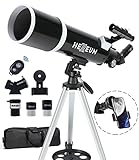
4. HEXEUM 80 mm Refractor Telescope
- Optimum Magnification: Our telescope for kids and adults is quipped with two replaceable excellent-quality eyepieces (25mm and 10mm) for 24X and 60X magnification. 3x Barlow lens trebles the magnifying power of each eyepiece. magnificate moon up to 72 or 180 times. Also with 5x24 finder scope makes locating objects easy.
- Excellent Quality Optics: This telescope is 600mm(f/6.7) focal length and 80mm aperture, 80mm aperture to capture more light picture and multi-fully high transmission coated all-optical lens enhance image brightness and clarity X
- Portable And Convenient: Comes with a phone adapter and an adjustable aluminum tripod. Wireless remote control and carrying bag make it easier for you portable and capture amazing images.
- Easy To Set Up: In order to save your time. Even for novices, no tools are required to set up the telescope. quick and easy to focus. Truly realize a no-tool-set telescope
- Satisfaction Quality: Lifetime maintenance. If you have any questions about the product and service, please feel free to contact us, we will do our best to help you in 24 hours
The HEXEUM 80 mm refractor telescope delivers a remarkably rich set of features for beginners and aspiring stargazers, starting with its 80 mm aperture and 600 mm focal length, which allow it to capture more light and produce brighter, clearer images than many basic entry-level scopes. Its fully multi-coated optics improve light transmission and overall image contrast, making details on the Moon and brighter planets easier to see with minimal optical distortion.
The package includes two eyepieces that provide a magnification range from about 24× to 60×, and a 3× Barlow lens triples this power, giving flexibility for both lunar observations and terrestrial viewing.
Assembly and usability are strong suits of this telescope. The included alt-azimuth mount paired with an adjustable aluminum tripod makes it intuitive to aim and track objects across the sky — an important feature for users new to astronomy.
Additionally, the package comes with a phone adapter, wireless remote control, and a carrying bag, enhancing portability and convenience for travel or backyard observing sessions.
Many users appreciate that no tools are required for setup, meaning novices can start observing quickly without frustration.
That said, while the optics and included accessories make this a compelling choice for beginners, it isn’t a professional-grade instrument. At higher magnifications, especially when trying to view faint deep-sky objects like nebulae or distant galaxies, the scope’s capabilities are limited by its basic mount and general budget design.
However, for the price and given its beginner-friendly optics and features, this telescope is an excellent first step into amateur astronomy and a solid gift choice for kids, families, or casual observers.
5. Celestron StarSense Explorer LT 80AZ App-Enabled Telescope
- SMARTPHONE-POWERED SKY TOUR: No experience needed! Just dock your phone, launch the StarSense Explorer app, and follow the on-screen arrows to locate stars, planets, nebulae, and more.
- PATENTED STARSENSE TECHNOLOGY: Unlike other astronomy apps, StarSense Explorer uses sky recognition technology to turn your phone into a celestial navigation system, analyzing star patterns overhead to pinpoint your telescope’s position.
- TONIGHT’S BEST TARGETS, INSTANTLY: The app generates a curated list of the top objects to see based on your time and location. See planets, bright nebulae, galaxies, and star clusters from the city—and even more from dark skies.
- SIMPLE SETUP, SMOOTH TRACKING: Features a manual altazimuth mount with altitude slow motion adjustment with a sliding rod. Follow the on-screen arrows to your target; when the bullseye turns green, you can view it clearly through the eyepiece.
- 80MM REFRACTOR WITH IMPRESSIVE VIEWS: The 3" Refractor with high-reflectivity coatings delivers sharp, vivid views of the Moon, planets like Jupiter and Saturn, and deep-sky favorites like the Orion Nebula and Andromeda Galaxy.
The Celestron StarSense Explorer LT 80AZ is built around an 80 mm refractor optical tube that delivers bright, clear views of the Moon, planets, and brighter deep-sky objects — a solid performance for a beginner instrument. What really sets it apart from basic entry-level telescopes is Celestron’s StarSense Explorer system, which uses your smartphone’s camera, gyroscope, and the companion app to calculate your position and guide you toward celestial targets in real time.
This means you don’t need to memorize star charts or struggle with pointing — the app shows arrows on screen to help you align the telescope with planets, stars, clusters, and nebulae easily.
Setup and use are straightforward, even for first-time skywatchers.
The telescope comes with essential accessories like two eyepieces, a 2× Barlow lens, a red-dot finder, and a smartphone dock that securely holds your phone while using the app.
The included alt-azimuth mount and full-height tripod give you intuitive control over movement, and the StarSense Explorer app’s step-by-step alignment makes it feel almost like having a guided tour of the night sky. For many beginners, this guided experience makes learning astronomical navigation far less intimidating than traditional star hopping.
That said, there are a few limitations to keep in mind. The 80 mm aperture — while decent for basic observing — limits light gathering and resolution, so dim deep-sky objects may appear faint or lack detail compared with larger scopes. Some reviewers and observers also note that the StarSense system’s benefit is strongest when you actually need finding help; for very bright, well-known objects like the Moon or Jupiter, you could locate them manually without much trouble.
Overall, though, for its price point and feature set, the StarSense Explorer LT 80AZ is an excellent choice for beginners, families, and anyone looking for an easy, tech-assisted way to explore the sky.
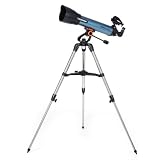
6. Celestron Inspire 100AZ Refractor Telescope
- Easiest setup of any entry level scope. With the folding accessory tray you just pop the tripod legs open, turn the lock knob and you’re ready to go.
- Bold new design - The main telescope lens cap comes with a fully integrated smartphone adapter built-in, perfect for the budding astrophotography.
- Red LED flashlight - Stowed in the center of the mount head, the flashlight can be used to gently illuminate the accessory tray or can be removed for use as a spotlight when needed.
- Focus micrometer - Allows quick return to a specific focus point for specific targets (bird nests, infinity focus, etc.)
- The asymmetrical mount design offers light weight and incredible stability. Erect image optics enables a fully correct image for easy viewing day or night, terrestrial or astronomical.
The Celestron Inspire 100AZ is a 100 mm refractor telescope that delivers impressive views for its price range, especially for beginners and casual observers. Its fully coated glass optics and generous aperture gather plenty of light, allowing clear observations of the Moon’s craters, planetary details on Jupiter and Saturn, and brighter deep-sky objects under darker skies.
The included 20 mm and 10 mm Kellner eyepieces provide a comfortable range of magnifications, and a built-in smartphone adapter lets you attach your phone for simple astrophotography — a fun feature for newcomers looking to capture lunar views or share photos with friends and family.
Assembly and everyday use are straightforward. The alt-azimuth mount with smooth panning controls and the adjustable tripod help users track objects across the sky without much fuss, and the integrated StarPointer® Pro red dot finderscope makes locating targets easier for beginners.
The telescope’s erect image diagonal means you can also enjoy bright daytime terrestrial viewing in addition to nighttime astronomy. Setup usually takes only a few minutes, making it a good choice for quick backyard observing sessions or impromptu stargazing trips.
However, there are a few trade-offs to consider. Some reviewers note that chromatic aberration (a slight color fringe on bright objects) can be visible, and the focuser and mount — while adequate — aren’t as refined as those found on more advanced scopes.
Compared to alternatives like Dobsonian reflectors of similar price, the Inspire 100AZ may deliver less aperture and stability, meaning you might see deeper objects better with other designs.
Still, for what it offers — bright optics, useful accessories, and ease of use — it’s a compelling beginner’s telescope that balances performance and convenience well.
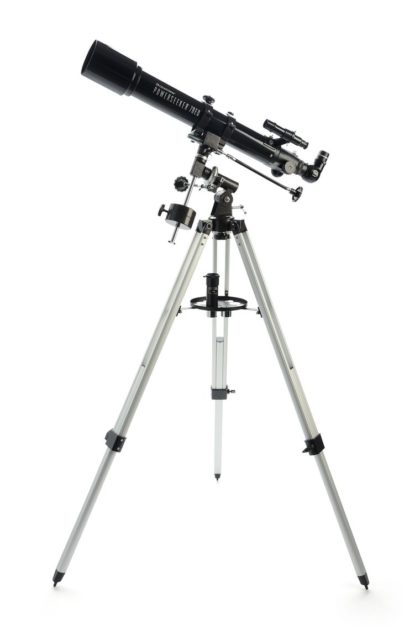
7. Celestron – PowerSeeker 70EQ
- PERFECT ENTRY-LEVEL TELESCOPE: The Celestron PowerSeeker 70EQ is an easy-to-use and powerful telescope. This 70mm refractor telescope offers enough light gathering ability to see planets, the Moon's craters, distant stars, the Orion Nebula, and more.
- MANUAL GERMAN EQUATORIAL MOUNT: With its slow-motion altitude rod, the German Equatorial mount allows you to navigate the sky with ease. Find celestial objects quickly and follow them smoothly & accurately as they appear to drift across the night sky.
- COMPACT AND PORTABLE: The ideal telescope for adults and kids to use together, the PowerSeeker is compact, lightweight, and portable. Take it to your favorite campsite, a dark sky observing site, or simply the backyard.
- MULTIPLE ACCESSORIES: The Celestron PowerSeeker 70EQ Telescope comes with 2 quality eyepieces (20mm and 4mm) plus a 3x Barlow lens to triple the power of each. You'll also receive a FREE download of one of the top-rated astronomy software programs.
- UNBEATABLE WARRANTY & SUPPORT: Buy with confidence from Celestron, a leading telescope brand in California since 1960. Your purchase includes a 2-Year US Warranty and unlimited support from our team of US-based experts.
The 70EQ Power Seeker is a refractor telescope with a 70mm aperture and a focal length of 700mm. Its low price combined with excellent optics, easy assembly, clear instructions, included eyepieces and other features that make it easy to use even for beginners, make it an excellent choice for anyone wanting to learn more about the nighttime sky.
At f/10, there is some chromatic aberration but nothing significant enough to ruin high-power views with this telescope. The optical quality of the Powerseeker 70 is quite good.
The scope’s focuser is a 1.25” rack-and-pinion made mostly of plastic. The focuser even includes a tension adjustment knob, should you find the focuser to be too loose or too tight.
Since Celestron 21037 PowerSeeker 70EQ telescope is a family-friendly scope, it is very easy to set up and use as it needs no extra tools. The instructions manual clearly describes every setup step, giving clear information on each of the telescope’s parts and uses.
With an aperture of 70 mm (2.76“) and a focal length of 700 mm (28”), the Celestron Power Seeker telescope allows stargazers to see the Moon, Jupiter, Saturn and other celestial wonders with ease.
The 3x Barlow lens manages to triple the magnifying power of all eyepieces, while the 1.25″ Erect Image Diagonal makes the telescope ideal for both astronomical and terrestrial use.
The telescope includes fully coated optics, meaning that at least one lens in the telescope has been coated with multiple layers of substances designed to capture and focus the light that goes through the lens.
The equatorial mount supplied with the 70EQ is actually a good match for it. The motions are reasonably smooth, the mount’s extruded aluminum legs are quite steady with such a lightweight tube. Furthermore, the whole setup is pretty light at about 14 pounds.
The 70EQ PowerSeeker is the best small telescope for astrophotography as it comes with a camera attachment that allows the user to take photographs of the objects being viewed.
Pros:
- Family-friendly, easy to setup and use
- Coated glass, decent optical components
- EQ mount with slow motion controls
- Budget option refractor telescope for astrophotography
- High and low power eyepieces
- Ideal for both terrestrial and celestial viewing
Cons:
- Not suitable for professional use
- Most components are built with plastic
Best Small Telescope Buying Guide
Buying a telescope for home use is an important step towards a new level of appreciation for the night sky, and the wonders found within it.
Wondering what features you should look for in a telescope? It helps when you know precisely what to look for in a telescope before you spend a fortune buying it. Many people feel frustrated if the brand they purchased couldn’t fulfill its purpose, this can be daunting especially if you are a beginner. What telescope should you buy? You can use the following explanation as a guide to enable you to choose the right telescope.
Features To Consider When Choosing A Good Small Telescope
Types of Telescopes
There are three types of telescopes and each one has their strong and weak points. They are categorized by the abilities to gather light and the way they go about it.
Refractor scopes are better than every other type at viewing through light pollution. Also, they are ideal for planetary and lunar observations.
Reflector scopes, on the other hand, are perfect for deep-sky observation and don’t perform excellently with light pollution. These scopes require regular alignment and adjustment if used regularly.
Compound scopes utilize a mix of reflector and refractor elements. They’re great for general observation of the sky, and they perform well even in areas with light pollution.
Aperture
The most important aspect of any telescope is its aperture, the diameter of its main optical component, which can be either a lens or a mirror.
The aperture of a telescope is the diameter of the light collecting region, assuming that the light collecting region has a circular geometry . For an optical instrument, the aperture is the diameter of the objective lens (refracting telescope) or the primary mirror (reflecting telescope). The larger the aperture, the more light the telescope can gather, and the fainter the limiting magnitude of the instrument. The field of view of the telescope decreases as the aperture increases, but the resolving power increases.
Focal Ratio
Another feature you should consider is the focal ratio. It is known as the speed of the optics. This characteristic depends on the focal length. You should look out for this crucial feature, usually the longer, the better. Use the following as a guide for focal ratio range.
f/3 to f/5 = fast, but lower power; best for deep space photography and observing full field f/6 – f/10 = slow, but higher power; best for narrower field viewing, photography of the moon, the planets, and binary stars
Focal Length
The focal length of a telescope has a direct influence on the amount of magnification. Basically, what this means is that the longer the scope’s focal length, the higher its magnification.
Do not assume that the tube length of the scope is its focal length. Complex scopes, despite having short tubes, usually deliver a sharp and clear image. This means that longer focal length is achievable through the proper combination of lenses and mirrors.
Magnification
Magnification of a telescope is actually a relationship between two independent optical systems: the telescope itself and the eyepiece you are using. To determine power, divide the focal length of the telescope (in mm) by the focal length of the eyepiece (in mm).
By exchanging an eyepiece of one focal length for another, you can increase or decrease the power of the telescope.
For example, a 20 mm eyepiece used on a 1000 mm focal-length telescope would yield a power of 50x (1000/20 = 50). While a 10mm eyepiece used on the same instrument would yield a power of 100x (1000/10 = 100). Since eyepieces are interchangeable, a telescope can be used at a variety of powers.
Eyepieces
An eyepiece uses the light gathered and focused to magnify objects and generate images. Most models include one, or two eyepieces with one optimized for wider field views and the other for higher magnification.
The focal length of both the telescope and the eyepiece influences the level of magnification. To calculate eyepiece magnification, divide the telescope focal length by the eyepiece focal length.
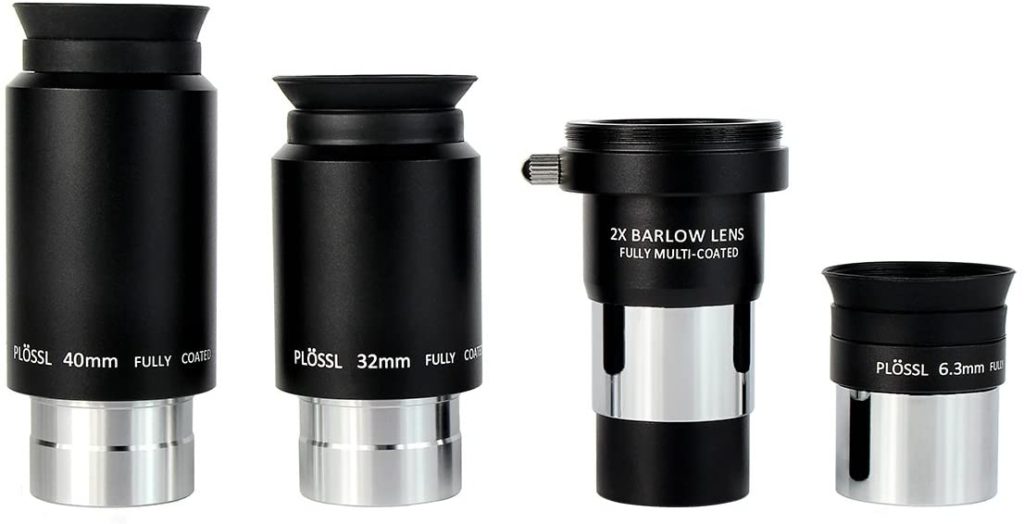
Eyepieces with shorter focal length have higher magnification. That means a 10 mm is more powerful than a 25 mm. A Barlow lens is inserted into the focuser to double or triple the eyepiece magnification power.
Types Of Mounts
The mount is a very important part of the telescope. Some types of telescopes are better suited for a particular type of mount. There are 4 main types.
Alt-Azimuth Mounts:
Alt-azimuth mounts are the simplest type of mount, and they are similar to a camera tripod. They allow you to move the telescope up and down and side to side. But it can be difficult to track the stars and make precise adjustments. For this reason they are mainly suited for smaller, low-power telescopes.
Equatorial Mounts:
Equatorial mounts allow a telescope to track the sky as Earth rotates. They do this with motor drives but do not necessarily require a computer system to track, although some equatorial mounts are computerized for finding objects.
Most equatorial mounts are German equatorial mounts, which use counterweights to balance the telescope. This type of mount is versatile and breaks down into smaller pieces, making even large telescopes portable.
Dobsonian Mounts:
The dobsonian is a variation of the alt-az mount, designed for reflectors. Instead of using tripod legs, it uses a heavy base that is often made of wood. This is a stable design that doesn’t cost a lot and allows for more precise movements.
Fork Mounts:
A fork mount is designed for shorter tube telescopes (usually the compound type). They are motorized and do not require a counterweight since the telescope is balanced at it’s center of mass. But they are often heavier than other types of mounts.
Weight
Depending on the sort of person you are, this factor may or may not be important to you. If you are intending to use your scope at a specific place and not to ever travel with it, then the weight may not really be a point of focus for you. And besides, half the delight of having a telescope is in showing it off. For that, you may decide to travel with the scope.
Conclusion
If you’re looking for the best small telescope, the Celestron Travel Scope 70DX Portable Refractor Telescope stands out as the top choice.
It strikes the ideal balance between portability, ease of use, and optical quality, making it perfect for beginners, travelers, and casual stargazers alike.
With clear views of the Moon and planets, a quick setup, and a complete accessory kit packed into a lightweight design, it’s a telescope you’ll actually use often—not one that sits in storage. For anyone who wants a compact, reliable, and beginner-friendly telescope, the Travel Scope 70DX is hard to beat.
ABOUT US
We are a team of active amateur astronomers, here to help you with all your astronomy and science related needs – this is anything, from reviewing the latest telescopes to be released to talking about gravity and neurons. The Big Bang Optics was started because of our love for astronomy and to help others like us find the best telescope and accessories.
LEGAL DISCLAIMER
The Big Bang Optics is a participant in the Amazon Services LLC Associates Program, an affiliate advertising program designed to provide a means for sites to earn advertising fees by advertising and linking to Amazon.com. The Big Bang Optics also participates in affiliate programs with Clickbank and other sites. The Big Bang Optics is compensated for referring traffic and business to these companies.